September 10, 2026
What Security Teams Need to Know About AI-Powered Threats
Introduction
Artificial intelligence is rapidly transforming cybersecurity.
For years, security platforms have used machine learning to detect anomalies, identify suspicious behavior, and assist analysts with threat detection. However, the rise of generative AI, autonomous agents, and advanced large language models (LLMs) is changing the cybersecurity landscape at an unprecedented pace.
Today, AI is no longer just a tool used by defenders. Attackers are increasingly leveraging AI to automate reconnaissance, generate convincing phishing content, identify vulnerable systems, and accelerate intrusion workflows.
For security teams, this creates a new challenge.
Organizations must not only defend against AI-powered threats, but also securely adopt AI technologies within their own environments.
The question is no longer:
“Should we use AI?”
The question has become:
“How can we securely monitor, manage, and defend against AI-related risks?”
How AI Is Transforming Cybersecurity
Artificial intelligence is influencing nearly every stage of the cyber kill chain.
Attackers can use AI to:
- Generate highly targeted phishing campaigns
- Automate vulnerability discovery
- Develop malicious code faster
- Conduct reconnaissance at scale
- Improve social engineering attacks
- Accelerate privilege escalation and lateral movement
At the same time, defenders are using AI to:
- Improve threat detection
- Reduce alert fatigue
- Enhance investigation workflows
- Enrich threat intelligence
- Automate repetitive security operations
This creates an ongoing arms race where both attackers and defenders are increasingly supported by artificial intelligence.

The Security Risks of AI Adoption
While AI provides significant benefits, it also introduces new attack surfaces and risks that organizations must understand.
Shadow AI
One of the fastest-growing concerns is Shadow AI.
Employees frequently adopt AI tools without approval from security or compliance teams. Sensitive corporate data may be uploaded into public AI systems without visibility or governance.
As a result, organizations often have limited awareness of:
- Which AI services employees are using
- What data is being shared
- Whether proprietary information is being exposed
Without proper monitoring, Shadow AI can quickly become a significant business risk.
Prompt Injection Attacks
Prompt injection has emerged as one of the most common attacks against LLM-powered applications.
In these attacks, malicious inputs are crafted to manipulate an AI system and cause it to ignore instructions, expose sensitive information, or perform unintended actions.
Unlike traditional software vulnerabilities, prompt injection specifically targets how AI models process instructions and context.
Security teams must therefore monitor both user inputs and model outputs to identify suspicious behavior.
Data Leakage Risks
AI systems often process large volumes of organizational data.
Misconfigured permissions, insecure integrations, or improper data handling can lead to unintended exposure of:
- Customer information
- Intellectual property
- Internal documentation
- Source code
- Confidential business data
As AI adoption increases, data governance becomes a critical security requirement.
Model Poisoning
Machine learning systems depend on data.
If attackers successfully manipulate training data or learning processes, they may influence model behavior.
Known as model poisoning, these attacks can reduce detection capabilities, introduce bias, or create conditions where malicious activity is more likely to go undetected.
What Security Teams Should Monitor
Many organizations focus exclusively on deploying AI while overlooking the visibility required to secure it.
A modern SOC should monitor:
- AI platform authentication activity
- Administrative changes to AI services
- API usage associated with AI platforms
- Prompt interaction patterns
- Data uploads and downloads
- User access to AI applications
- Third-party AI integrations
- Unusual cloud activity
- Privilege changes
- Large-scale data access patterns
Visibility is often the difference between secure adoption and unmanaged risk.
How SIEM Helps Detect AI-Related Threats
AI-related security events rarely occur in isolation.
A suspicious prompt, unusual account activity, abnormal API usage, and excessive data downloads may each appear harmless individually.
Together, however, they can indicate a larger security incident.
Modern SIEM platforms help organizations centralize this telemetry and correlate events across multiple systems.
By collecting activity from identities, endpoints, cloud environments, applications, and AI platforms, security teams can gain a broader understanding of emerging threats.
This allows analysts to move beyond isolated alerts and focus on relationships between events.
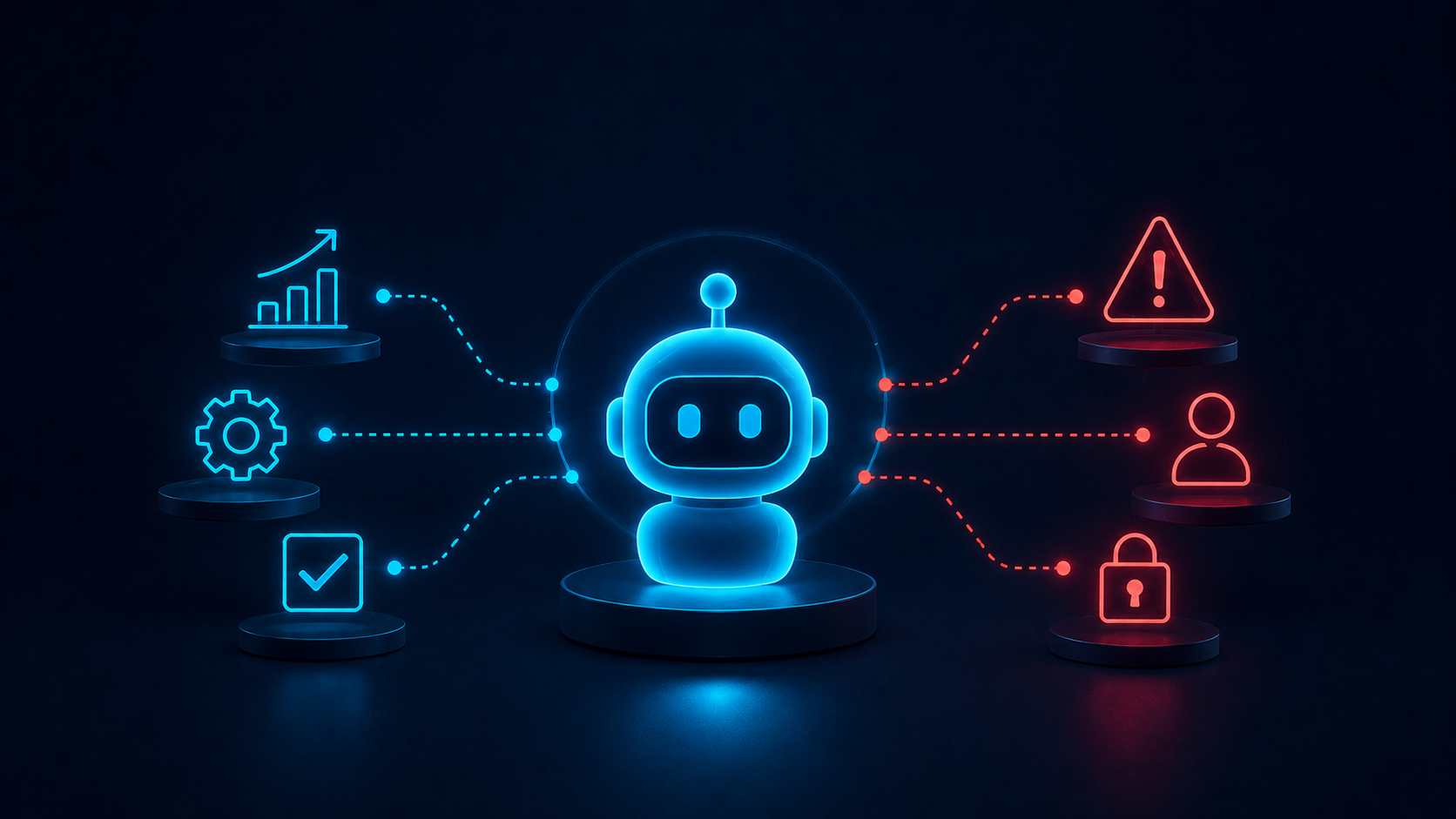
Real-World Example
Consider a software development team that adopts an AI coding assistant to accelerate application development.
A developer uploads portions of internal source code to a third-party AI platform to troubleshoot an API issue. Over the following days, several unusual events begin to appear across the environment:
- Large volumes of source code are uploaded to an external service.
- A user account generates a significantly higher number of API requests than normal.
- Multiple new AI-related domains appear in DNS and web proxy logs.
- Authentication activity increases outside normal working hours.
- Sensitive repositories are accessed more frequently than usual.
- Cloud storage activity spikes shortly after interactions with the AI platform.
Viewed individually, these events may not immediately appear suspicious. A developer troubleshooting code, accessing repositories, and using cloud services is often normal business activity.
However, when identity logs, proxy logs, DNS activity, cloud telemetry, and application events are correlated within Logstail SIEM, analysts can identify a broader pattern indicating potential Shadow AI usage and possible data exposure.
The security team can then investigate:
- Which users interacted with the AI platform.
- What systems and repositories were accessed.
- Whether sensitive data was uploaded.
- Whether organizational AI usage policies were violated.
- Whether additional containment actions are required.
If the activity is confirmed to pose a security risk, Logstail SOAR can help automate parts of the response process, such as opening an investigation case, enriching alerts with contextual information, notifying stakeholders, and initiating predefined response workflows.
This allows the organization to identify potentially risky AI usage early, reduce the likelihood of data leakage, and maintain visibility into how AI technologies are being used across the enterprise.
How Logstail Academy Helps Security Teams Prepare for AI Security
- AI security fundamentals and governance
- Prompt injection attacks and LLM security
- Shadow AI detection and risk management
- Data leakage prevention and monitoring
- Threat detection and threat hunting
- Security monitoring and log analysis
- SIEM-driven investigations
- Incident response and case management
- Security operations center (SOC) workflows
- Threat intelligence and event correlation
- Cloud security monitoring
- Security automation and response processes
By combining AI security knowledge with hands-on monitoring and incident response skills, organizations can build the expertise required to securely adopt AI technologies while maintaining visibility, reducing risk, and improving their overall cybersecurity posture.
How Logstail Helps Security Teams Monitor AI Risks
As organizations adopt more AI technologies, maintaining visibility becomes increasingly important.
Logstail SIEM helps security teams centralize monitoring across:
- Identity platforms
- Cloud services
- Endpoints
- Applications
- Security tools
- AI-enabled environments
Through centralized visibility and event correlation, analysts can investigate suspicious activity associated with AI tools, detect unusual user behavior, and identify potential indicators of compromise faster.
Rather than manually reviewing disconnected logs, analysts gain a unified view of security activity across the environment.
Accelerating Response with Logstail SOAR
Detection is only part of the challenge.
Once suspicious AI-related activity is identified, security teams must investigate and respond efficiently.
Logstail SOAR helps organizations streamline incident response through:
- Automated investigations
- Alert enrichment
- Threat intelligence lookups
- Case management
- Playbooks
- Automated response workflows
These capabilities reduce manual effort while helping analysts focus on higher-value security activities.
Key Takeaways
Artificial intelligence is transforming cybersecurity for both attackers and defenders.
While AI offers significant advantages in automation, threat detection, and operational efficiency, it also introduces new risks that organizations cannot ignore.
Security teams must maintain visibility into AI usage, monitor for emerging threats, and establish governance processes that support secure adoption.
By combining strong security operations, continuous monitoring, automated response capabilities, and ongoing training, organizations can embrace AI while maintaining control over the risks it introduces.
Ready to Secure AI Adoption?
Discover how Logstail SIEM and Logstail SOAR help organizations monitor AI-related activity, investigate emerging threats, and improve visibility across modern environments.
Organizations should treat AI-generated code as a productivity tool rather than a trusted security authority. Every generated output should undergo proper review, validation, and testing before deployment.
By combining secure development practices, continuous monitoring, security automation, and ongoing training, organizations can benefit from AI-driven development while reducing exposure to software vulnerabilities.