
October 9, 2026
Attackers Don’t Need Malware Anymore: The Rise of SaaS Attacks
Introduction
For years, security teams focused heavily on detecting malware. A suspicious executable appears on an endpoint. Antivirus detects malicious activity. An analyst investigates processes, network connections, and indicators of compromise to determine the impact. While malware remains an important threat, many modern attacks no longer require malicious software at all.
Instead of deploying malware, attackers increasingly abuse legitimate cloud services, stolen credentials, OAuth permissions, SaaS applications, and trusted third-party integrations to gain access and persist within an environment. This shift has fundamentally changed the attack surface organizations must defend.
Today, applications such as Microsoft 365, Google Workspace, Salesforce, Slack, GitHub, Dropbox, and numerous other Software-as-a-Service (SaaS) platforms contain some of the most valuable organizational data. They also provide attackers with opportunities to operate using legitimate identities and trusted services, making detection significantly more challenging.
For defenders, the question is no longer simply:
“Is malware present?”
It increasingly becomes:
“Is this activity legitimate?”
Understanding how attackers abuse SaaS platforms is now a critical requirement for modern security operations teams.
Understanding Modern SaaS Attacks
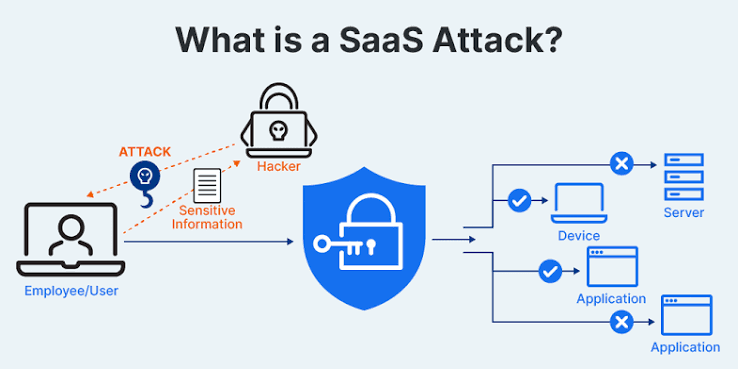 A SaaS attack occurs when an adversary abuses a cloud-hosted software platform to gain unauthorized access, steal data, establish persistence, or conduct malicious activities. Unlike traditional attacks that often rely on malware deployment, SaaS attacks frequently leverage legitimate functionality that already exists within cloud applications.
Common targets include:
- Microsoft 365
- Google Workspace
- Salesforce
- Slack
- GitHub
- Dropbox
- ServiceNow
- Jira
- Box
Attackers understand that these platforms often contain sensitive emails, intellectual property, source code, credentials, financial information, and internal business communications. As organizations continue moving workloads to the cloud, SaaS platforms have become increasingly attractive targets.
One of the biggest advantages for attackers is that many SaaS attacks require little or no malware.
Instead of exploiting endpoints, attackers may simply:
Steal credentials
- Hijack sessions
- Abuse OAuth applications
- Exploit weak access controls
- Use compromised third-party integrations
Because the attacker is often using legitimate authentication mechanisms, traditional malware-based detections may never trigger. This significantly reduces visibility for security teams relying heavily on endpoint-centric defenses.
Many SaaS attacks closely resemble normal business operations.
Consider a user who:
- Logs into Microsoft 365
- Opens email
- Downloads files
- Shares documents
- Creates forwarding rules
These are all legitimate actions. Unfortunately, they are also actions an attacker may perform after compromising an account.This makes distinguishing between legitimate activity and malicious behavior much more difficult. The challenge is no longer identifying malware. The challenge becomes identifying abnormal behavior within otherwise legitimate activity.
Many organizations still struggle to maintain consistent visibility across SaaS environments.
Security teams may have excellent monitoring for:
- Endpoints
- Firewalls
- Servers
- Active Directory
But limited visibility into:
- OAuth permissions
- Third-party applications
- Cloud authentication events
- SaaS administrative actions
- Data-sharing activities
Attackers frequently exploit these visibility gaps to operate unnoticed for extended periods.
Common SaaS Attack Techniques
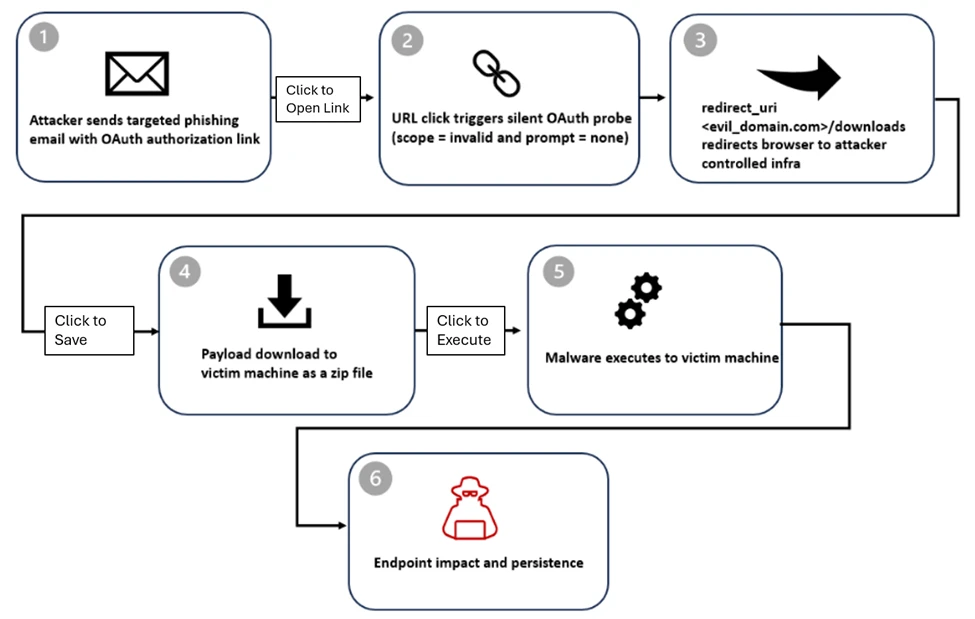 OAuth Consent Abuse
OAuth consent attacks have become one of the most effective methods for compromising SaaS environments. Instead of stealing passwords, attackers create malicious applications and trick users into granting permissions. A victim may receive what appears to be a legitimate Microsoft 365 application request.
Once approved, the attacker may gain access to:
- Emails
- Contacts
- Calendars
- Files
- User profile data
Importantly, this access often survives password changes because the attacker is operating through the authorized application rather than directly through stolen credentials. This makes OAuth abuse particularly dangerous.
Business Email Compromise (BEC)
Business Email Compromise remains one of the most financially damaging attack techniques.
After gaining access to an email account, attackers may:
- Monitor communications
- Hijack conversations
- Request fraudulent payments
- Redirect invoices
- Harvest additional credentials
Because the attacker is operating from a legitimate mailbox, traditional security controls may not immediately identify the activity as malicious.
Stolen Session Tokens
Modern attackers increasingly target authenticated sessions rather than passwords. If a session cookie or authentication token is stolen, an attacker may gain access without needing to authenticate again.
This can effectively bypass security controls such as:
- Password resets
- MFA prompts
- Conditional access policies
To the SaaS platform, the session may appear completely legitimate.
What Security Teams Should Monitor
One of the biggest challenges with SaaS attacks is that malicious activity often appears legitimate. Unlike traditional malware infections, attackers frequently use valid credentials and trusted cloud applications to perform their actions. As a result, security teams must focus on monitoring behavior rather than simply looking for known indicators of compromise.
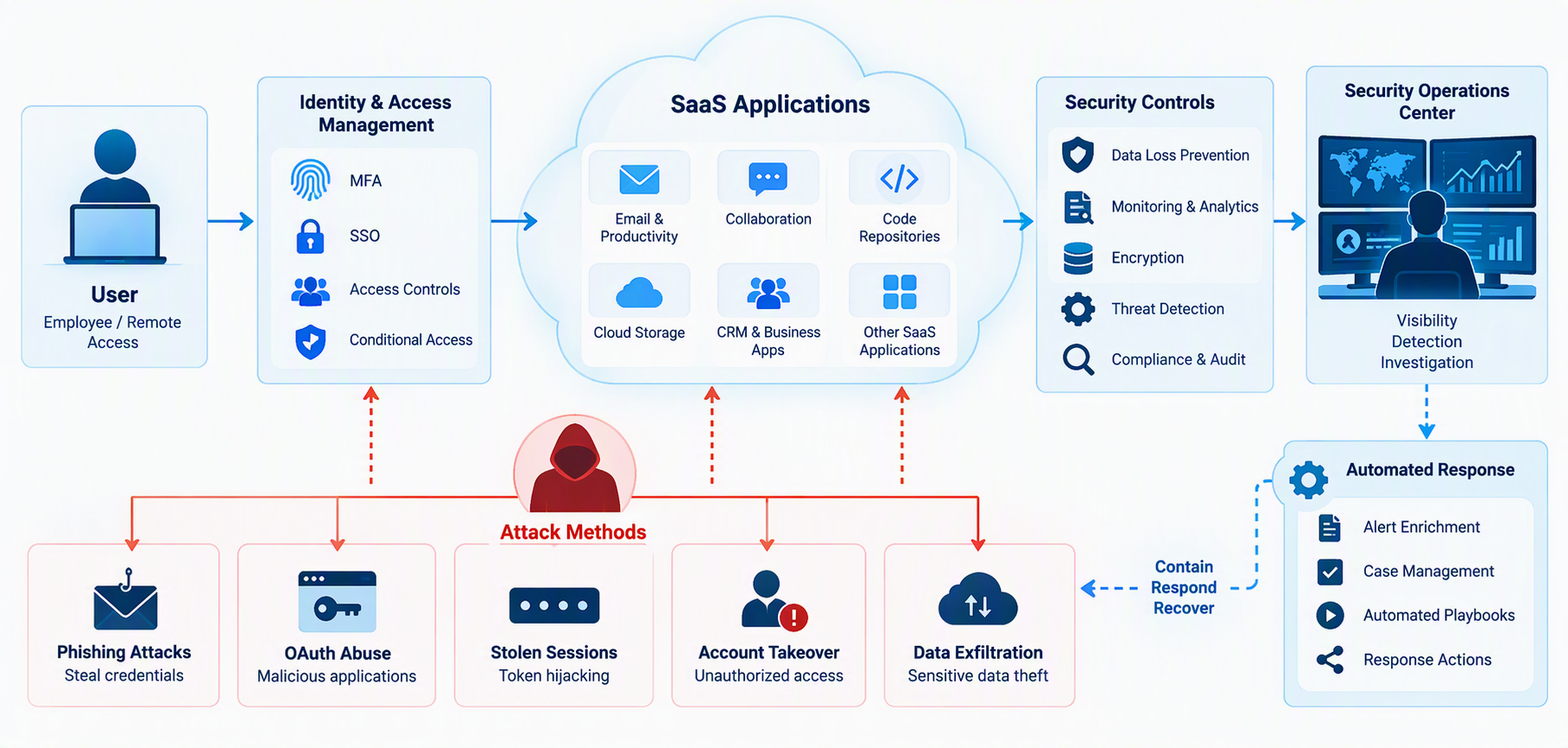
- Successful and failed authentication attempts
- New OAuth application approvals
- Unusual login locations
- Impossible travel events
- Excessive file downloads
- Administrative changes
- Mail forwarding rules
- New third-party integrations
- Permission modifications
- Unusual API activity
Monitoring these events individually is important, but the real value comes from correlating them and understanding the context behind the activity. A user downloading several files may be normal. A user downloading several hundred files immediately after approving a new OAuth application and authenticating from a previously unseen location should receive much closer attention.
When a Normal SaaS Login Becomes Suspicious
Consider a simple scenario. An employee normally accesses Microsoft 365 from Athens during standard working hours.
One morning:
- A successful login occurs from another country.
- The account approves a new OAuth application.
- Mail forwarding rules are created.
- Sensitive documents are accessed.
- Multiple files are downloaded shortly afterward.
None of these activities independently proves malicious intent. When viewed together, however, they create a significantly stronger indication that the account may have been compromised. This demonstrates why SaaS attack detection increasingly depends on context and event correlation rather than individual alerts.
How the Logstail Platform Supports SaaS Threat Detection and Response
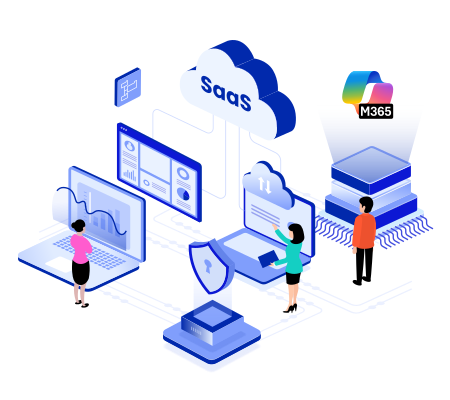 Modern SaaS attacks generate evidence across multiple platforms. Authentication logs may exist in Microsoft 365, application activity in cloud services, file access events in collaboration platforms, and network telemetry elsewhere. Without centralized visibility, analysts may struggle to piece together the full picture. Logstail SIEM helps organizations centralize SaaS security monitoring by collecting, normalizing, and correlating security events from cloud applications, identity providers, endpoints, and other security technologies.
This allows security teams to:
- Detect suspicious SaaS activity
- Investigate identity-based attacks
- Correlate events across multiple platforms
- Improve visibility into cloud environments
- Accelerate incident investigations
Instead of reviewing isolated logs, analysts can investigate SaaS threats from a single platform and gain greater context around suspicious activity.
How Logstail SOAR Accelerates Response
Detection alone is not enough. Once suspicious SaaS activity has been identified, organizations must investigate and respond quickly.
Logstail SOAR helps streamline this process through:
- Alert enrichment
- Case management
- Investigation workflows
- Automated response actions
- Threat intelligence integrations
- Incident documentation
By automating repetitive tasks and standardizing response procedures, security teams can reduce investigation time and improve overall operational efficiency. This becomes particularly valuable during SaaS incidents where multiple systems, identities, and cloud services may be involved. Technology is only one part of successful SaaS security. Security analysts must understand how cloud platforms work, how attackers abuse legitimate services, and how to investigate suspicious SaaS activity effectively.
Through Logstail Academy, security professionals can build practical skills in:
- Security monitoring
- Threat detection
- Incident response
- Log analysis
- SIEM investigations
- Cloud security
- Identity-based attack detection
Learning paths focused on SOC operations and incident response help analysts develop the knowledge required to identify, investigate, and respond to modern SaaS-based threats.
Key Takeaways
- SaaS platforms have become a major target for attackers.
- Modern attacks often abuse legitimate cloud services instead of deploying malware.
- Identity, OAuth permissions, and cloud applications are increasingly important attack surfaces.
- Security teams must focus on visibility, monitoring, and event correlation.
- SIEM and SOAR technologies help organizations detect and respond to SaaS attacks more effectively.
- Continuous training and awareness remain critical as SaaS environments continue to grow.
Ready to Improve Visibility Into SaaS Threats?
Discover how Logstail SIEM and Logstail SOAR help security teams monitor SaaS environments, detect suspicious cloud activity, investigate identity-based threats, and accelerate incident response across modern organizations.