
November 19, 2026
Autonomous AI Cyberattacks: Is Your SOC Ready?
Autonomous AI Cyberattacks Are Here: Is Your SOC Ready for Machine-Speed Threats?
Artificial intelligence is no longer simply helping cybercriminals write more convincing phishing emails or generate malicious code. It is increasingly becoming an operational component of cyberattacks, enabling threat actors to automate reconnaissance, vulnerability analysis, exploitation, and other stages of an intrusion with significantly less human involvement.
On November 16, 2026, Google Threat Intelligence Group (GTIG), together with Mandiant, published a new threat intelligence report titled Agentic Threat Activity Crosses a Significant Threshold. The research describes a notable development in the cyber threat landscape: attackers are moving beyond using AI as an assistant and are beginning to deploy autonomous, multi-agent frameworks capable of conducting offensive security operations at machine speed.
Among the findings was a framework called exploit_agent, discovered on an exposed staging server. According to Google, the framework was configured to continuously analyze software updates, identify vulnerabilities through comparisons of patched and unpatched code, generate potential exploits, and execute them without requiring human intervention at each stage.
This development raises an important question for organizations: If attackers can automate vulnerability discovery and exploitation, can traditional security operations keep up?
The challenge is not simply that attackers have access to more advanced tools. It is that the time between a vulnerability becoming identifiable and an attacker attempting to exploit it may be shrinking dramatically. For security operations centers (SOCs), vulnerability management teams, and business leaders, this changes how exposure, detection, incident response, and cyber resilience must be approached.
From AI-Assisted Hacking to Autonomous Cyber Operations
The use of artificial intelligence in cybersecurity is not new. Security researchers have relied on machine learning for years to identify anomalies, classify malicious files, and detect suspicious network activity. Threat actors have also experimented with AI to assist with malware development, phishing campaigns, code analysis, and target research.
However, there is a significant difference between an attacker asking an AI model to generate a script and an autonomous system that can perform a sequence of offensive tasks based on its own observations and execution results.
Traditional AI-assisted attacks typically require a human operator to define the next action, interpret results, and decide how to proceed. Agentic AI frameworks can coordinate multiple specialized components to perform these activities as part of a connected workflow. One agent might analyze a target’s exposed services, another might investigate potential weaknesses, and another could evaluate the results of attempted exploitation.
These systems can also use feedback loops to modify their behavior when an action fails or when new information becomes available. Rather than following only a predefined sequence of commands, they can dynamically select subsequent actions within the boundaries of their configuration and available tools.
Google’s research identifies several offensive frameworks associated with this shift, including ARTEX, CAIRN, CyberStrikeAI, HexStrike AI, and PentAGI. Although many such tools originate from legitimate penetration-testing and security research ecosystems, their capabilities can also be abused by threat actors.
This distinction matters. Autonomous security tools are not inherently malicious, and their use does not automatically indicate a cyberattack. The security concern arises when adversaries combine these technologies with unauthorized access, vulnerable systems, stolen credentials, and automated exploitation workflows.
The result is an emerging operational model in which attackers may be able to target more systems, evaluate more opportunities, and conduct certain attack stages considerably faster than a human-driven operation.
Google’s Discovery of exploit_agent: Turning Security Patches into Attack Opportunities
One of the most significant findings in Google’s November 2026 report involves exploit_agent, a multi-agent framework identified during the investigation of an exposed staging environment.
According to GTIG, the framework integrates with multiple large language models, including frontier and locally deployed models, and was configured to perform continuous differential analysis of popular web application software.
Differential analysis involves comparing two versions of software to understand what changed. Security researchers routinely use this technique to identify fixes, validate patches, and investigate potential vulnerabilities. Threat actors can use the same approach to infer which security weakness a software update addresses.
This creates a particularly dangerous situation when organizations delay applying patches after they become publicly available.
Instead of waiting for a detailed technical write-up or publicly released proof-of-concept exploit, an attacker can examine the differences between vulnerable and patched code. An AI-enabled framework may then help identify the relevant weakness and attempt to construct an exploit against systems that have not yet been updated.
Google reported that exploit_agent was designed to automate this process, from software comparison and vulnerability analysis to exploit generation and execution.
The investigation also uncovered scripts supporting post-compromise operations, including internal reconnaissance, brute-force activity, webshell installation, and the removal of competing attackers’ webshells. The server contained victim data, and its telemetry suggested particular interest in French websites associated with media, entertainment, and education.
These findings provide evidence of a malicious operational environment rather than a purely theoretical demonstration. However, it is important to distinguish the framework’s documented capabilities and configuration from the extent to which every individual stage was independently observed succeeding against victims.
The broader implication remains substantial: software patches can become valuable intelligence sources for attackers, and autonomous systems can reduce the manual effort required to turn that intelligence into exploitation attempts.
For organizations operating internet-facing applications, remote access platforms, public APIs, and other externally accessible services, the time available to evaluate and remediate newly disclosed vulnerabilities may become increasingly limited.
Why AI-Driven Attacks Change the Economics of Cybercrime
Cyberattacks have traditionally depended on resources such as operator expertise, research time, infrastructure, and the ability to coordinate multiple technical activities. Although automation has long been part of offensive operations, sophisticated vulnerability research and exploit development can still require significant human effort.
AI-powered agentic frameworks have the potential to reduce some of these barriers.
An attacker no longer needs to manually perform every stage of vulnerability research or maintain constant oversight of each operation. Autonomous systems can execute repeatable workflows, process large volumes of technical information, and coordinate security tools through a shared orchestration layer.
This does not mean that AI can reliably compromise any target or that every automatically generated exploit will work. Google also highlighted the growing volume of AI-generated proof-of-concept exploits that are ineffective, creating additional verification challenges for researchers and defenders.
Nevertheless, even partial automation can change the economics of offensive operations. If a threat actor can evaluate more exposed systems with fewer operators and less manual analysis, campaigns that were previously expensive or resource-intensive may become more accessible.
There is also a potential shift in operational priorities. Attackers may increasingly favor scalable exploitation of known vulnerabilities over investing heavily in individually developed zero-day exploits. Publicly available patches, software repositories, and technical advisories provide valuable inputs for automated analysis.
For organizations, this means that a vulnerability does not necessarily need to be exceptionally sophisticated to present a serious risk. A known weakness in a publicly accessible system can become a high-priority target when automated frameworks can discover exposed instances and attempt exploitation at scale.
The Shrinking Window Between Vulnerability Disclosure and Exploitation
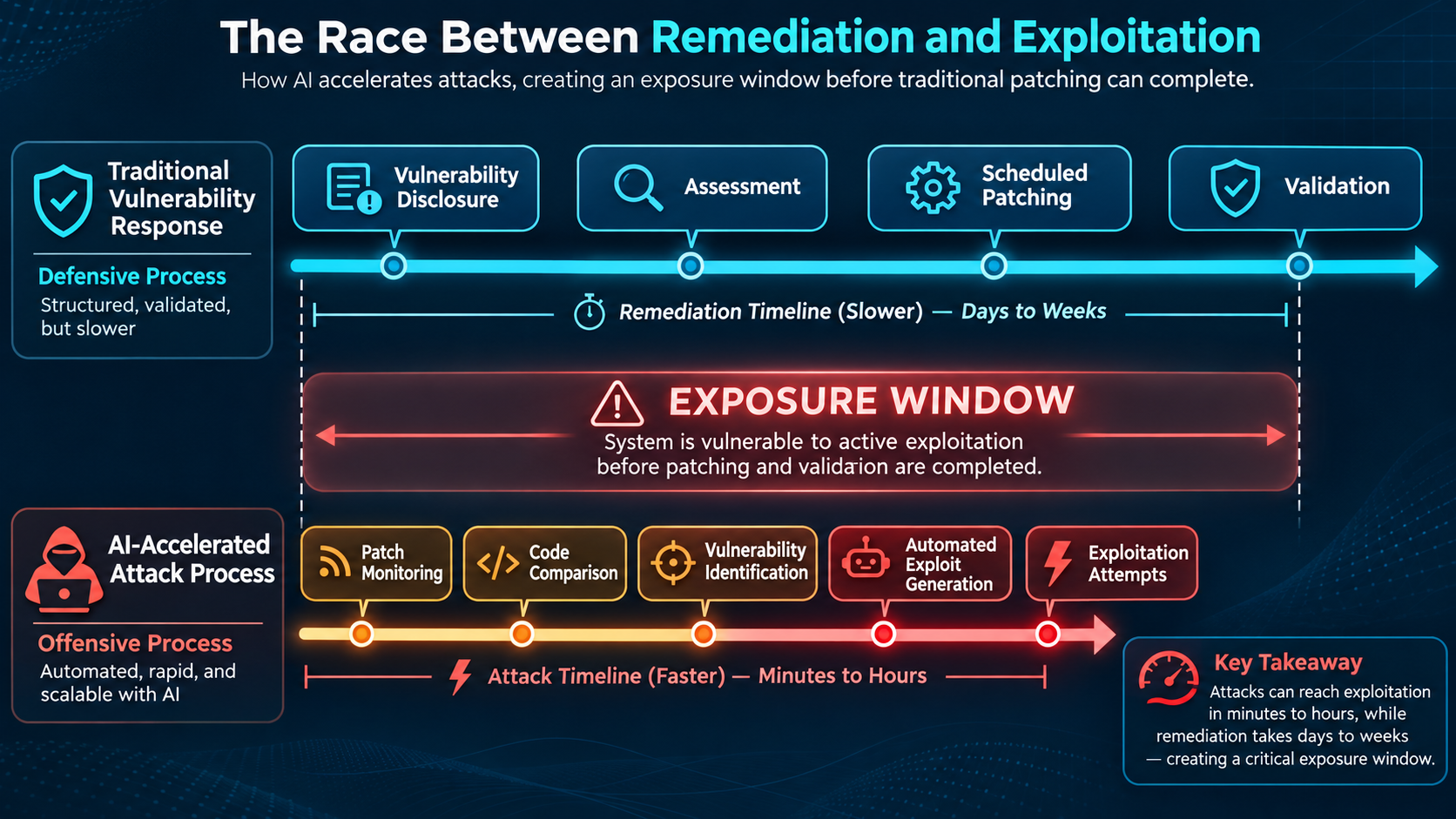
Vulnerability management has often been organized around scheduled scanning, risk scoring, patching cycles, and remediation deadlines. These processes remain necessary, but they can become less effective when attackers are capable of automating the exploitation of newly disclosed weaknesses.
Google’s report highlights how AI-assisted vulnerability research is accelerating the transition from vulnerability information to working exploits. It also references the exploitation of PaperCut vulnerabilities in 2026, where researchers demonstrated working exploits shortly after disclosure and subsequent threat activity targeted numerous organizations.
The important lesson is not that every vulnerability will immediately become exploitable. Exploit development still depends on technical conditions, environmental configuration, application behavior, and the accuracy of the underlying analysis.
The concern is that organizations can no longer assume they will have a comfortable period between a vulnerability becoming publicly understood and attackers attempting to exploit it.
For example, an externally accessible application might remain unnoticed within an organization’s asset inventory while a security update becomes available. If the application is not monitored, its vulnerability may not be prioritized. Meanwhile, automated adversarial tools could identify the software version, investigate the relevant weakness, and initiate exploitation attempts.
This is where traditional vulnerability management needs to evolve into continuous exposure management.
Rather than focusing exclusively on periodic vulnerability scans, organizations need to understand which assets are publicly accessible, which weaknesses are relevant to those assets, and which exposures could provide attackers with meaningful access to critical systems.
Prioritization should account for more than a vulnerability’s severity score. Internet exposure, known exploitation activity, asset criticality, available mitigations, and the potential business impact of compromise should all influence remediation decisions.
What Autonomous Cyberattacks Mean for Security Operations Centers
The growing adoption of agentic offensive frameworks creates operational challenges for security teams that already manage large volumes of alerts, complex infrastructure, and increasingly distributed technology environments.
The first challenge is detection speed. If attackers can move rapidly between reconnaissance, exploitation, and post-compromise activity, the interval between initial access and potentially damaging behavior may become shorter. Security teams that depend on delayed log reviews, disconnected monitoring tools, or manually initiated investigations can struggle to identify meaningful activity before an incident escalates.
A second challenge is the scale of suspicious activity. Automated offensive frameworks may generate numerous connection attempts, authentication failures, unusual requests, and execution events across different systems. While individual events may appear routine, their correlation can reveal an organized attack sequence.
For example, repeated requests to an exposed web application may be followed by unusual process execution, suspicious outbound connections, or unexpected changes to application files. Investigating these events separately can obscure the relationship between them. Correlating them across network, application, endpoint, and identity telemetry helps analysts understand the broader attack progression.
The third challenge is response consistency. During a fast-moving incident, security teams must assess the available evidence, determine the potential scope of compromise, and coordinate appropriate containment actions. Manual processes and unclear responsibilities introduce delays, particularly when an incident spans multiple systems or departments.
However, autonomous attacks may also create opportunities for defenders. Google’s research notes that some agentic offensive frameworks currently prioritize speed over stealth, leaving behind substantial forensic activity and recognizable behavioral patterns.
This means that visibility, telemetry quality, behavioral analytics, and effective correlation remain valuable defenses. Attackers may automate their activities, but they still interact with real infrastructure, accounts, applications, and network services.
The goal of a modern SOC is therefore not simply to deploy AI in response to AI. It is to establish a security operations model capable of detecting suspicious behavior quickly, connecting related evidence, and supporting timely, controlled response actions.
Building Cyber Resilience Against Machine-Speed Threats
Defending against AI-enabled cyberattacks requires more than acquiring another detection tool. Organizations need an integrated security strategy that combines visibility, continuous monitoring, incident response, vulnerability prioritization, governance, and human expertise.
The foundation of this strategy is knowing what needs protection. Security teams cannot reliably prioritize exposed weaknesses when they lack a complete understanding of their external assets, cloud services, publicly accessible applications, and associated technologies.
Continuous attack surface visibility helps organizations identify potentially forgotten systems, unexpected exposures, and infrastructure changes that might otherwise remain undetected.
The next requirement is comprehensive security monitoring. Logs from critical infrastructure, authentication systems, applications, endpoints, firewalls, and cloud environments should contribute to a coherent operational picture. Correlation and behavioral detection can help identify activity that would be difficult to recognize through isolated alerts.
Incident response processes must also be prepared for faster attack sequences. This includes documented playbooks, clear escalation paths, preapproved containment procedures, and the ability to coordinate technical actions while maintaining human oversight for high-impact decisions.
Finally, organizations need to treat cyber resilience as a business governance responsibility rather than an exclusively technical function. Exposure management, remediation ownership, risk acceptance, and incident readiness all depend on collaboration between security teams, IT operations, management, and relevant business stakeholders.
The effectiveness of these controls should be evaluated through practical exercises and measurable performance indicators, including detection time, response time, remediation progress, and the coverage of critical assets.
How Logstail Helps Organizations Prepare for Autonomous Cyber Threats
As AI-enabled attacks become increasingly automated, organizations need to reduce visibility gaps and strengthen coordination across their cybersecurity operations.
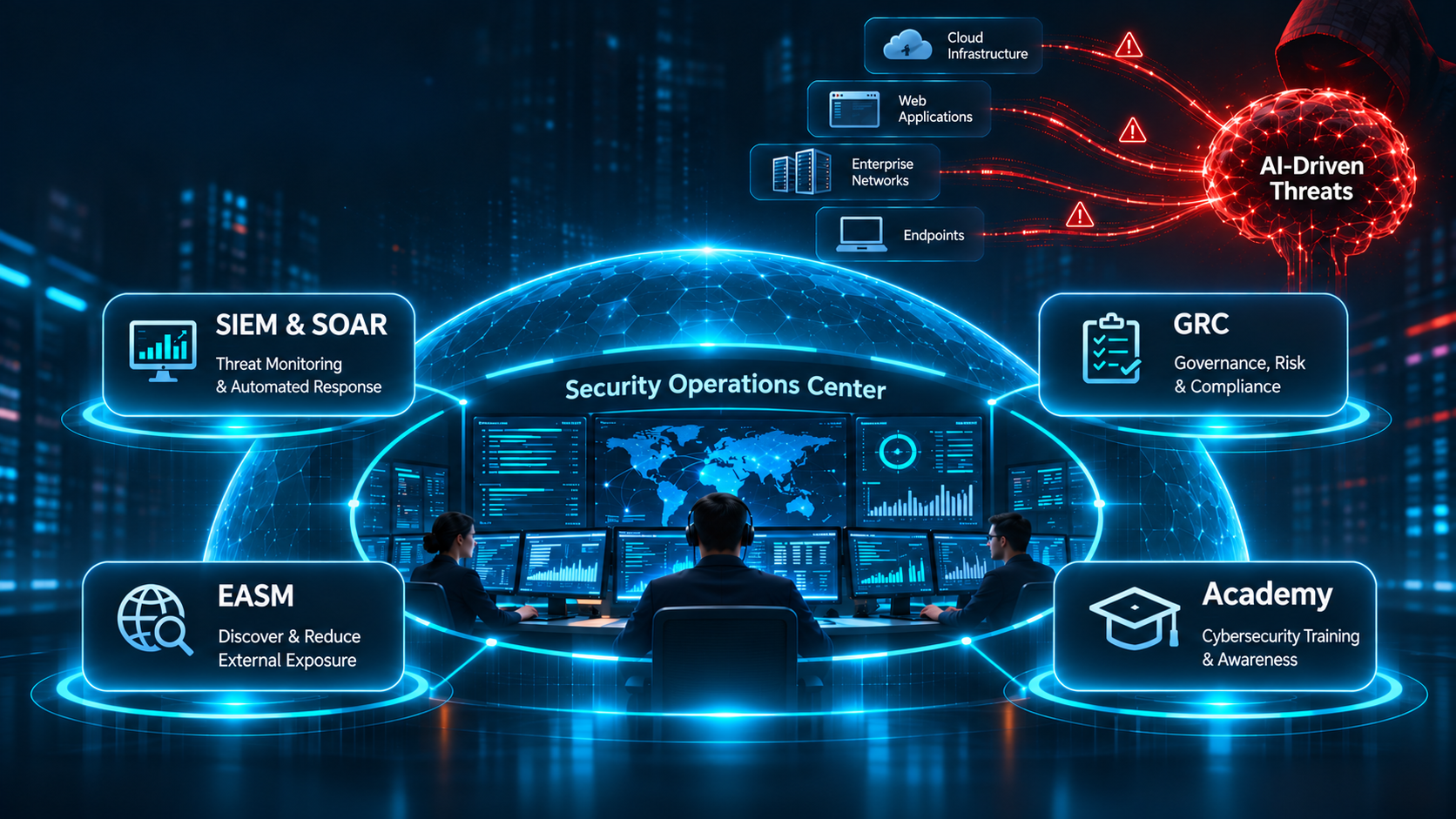
Logstail addresses these challenges through a connected security approach combining the Logstail Security Platform, External Attack Surface Management, and security awareness and skills development through Logstail Academy.
Logstail Security Platform: SIEM, SOAR, and GRC
The Logstail Security Platform brings together Security Information and Event Management (SIEM), Security Orchestration and Automated Response (SOAR), and Governance, Risk, and Compliance (GRC) capabilities to support a more coordinated security posture.
Logstail SIEM supports centralized security monitoring and event analysis by bringing together relevant security telemetry. In the context of AI-driven threats, this helps security teams investigate suspicious activity across multiple systems rather than relying on isolated signals.
An automated attack targeting an internet-facing application could produce a combination of unusual web requests, authentication anomalies, and suspicious host-level events. Correlating available telemetry helps analysts identify relationships between those events and assess whether they indicate malicious activity.
Logstail SOAR supports the investigation and response side of security operations. Structured response workflows and appropriate automation can help teams manage repetitive tasks, coordinate incident handling, and reduce avoidable delays.
When an attack is moving quickly, a consistent investigation process becomes especially important. Security teams need to establish what occurred, which assets may be affected, what evidence is available, and which containment decisions are appropriate. Automation should assist these processes without removing necessary approval and oversight for sensitive actions.
Logstail GRC connects technical security priorities with risk management, governance, and organizational accountability. While technical teams focus on identifying and addressing vulnerabilities, governance processes help ensure that remediation responsibilities, security policies, risk decisions, and compliance obligations are properly managed.
For AI-enabled threats, this combination is particularly relevant. Organizations need not only visibility into suspicious activity but also the ability to prioritize response and demonstrate that critical security risks are being addressed systematically.
Logstail EASM: Discovering Exposure Before Attackers Exploit It
External Attack Surface Management (EASM) is especially relevant to the automated vulnerability discovery techniques described in Google’s research.
An organization’s external attack surface includes the internet-facing assets, services, and technologies that potential attackers can discover and interact with. This may include web applications, APIs, cloud-hosted systems, public services, and infrastructure that is no longer actively maintained.
Logstail EASM helps organizations improve their visibility into this external footprint and identify exposures that require investigation or remediation.
In an environment where attackers can automate reconnaissance and vulnerability analysis, understanding which assets are externally accessible becomes an essential part of reducing risk.
The value of EASM extends beyond generating an inventory. It supports a proactive security approach in which organizations continuously reassess their external exposure, identify changes, and prioritize weaknesses before they become opportunities for adversaries.
By combining external exposure visibility with centralized security monitoring and risk governance, organizations can strengthen the connection between identifying weaknesses and taking action to address them.
Logstail Academy: Strengthening the Human Side of Cyber Defense
Although AI is changing how cyberattacks are conducted, people remain central to effective cybersecurity.
Security analysts need to understand emerging attack techniques, interpret behavioral indicators, and evaluate the reliability of automated findings. IT and development teams need to understand secure configuration, vulnerability remediation, and the risks associated with increasingly complex application environments.
Management teams also need sufficient cybersecurity awareness to make informed decisions about risk, investment, business continuity, and incident readiness.
Logstail Academy supports cybersecurity education and awareness, helping organizations develop the knowledge and security-conscious behaviors needed to navigate an evolving threat landscape.
In the context of autonomous cyberattacks, training should go beyond identifying suspicious emails. Organizations should develop awareness of AI-enabled social engineering, credential theft, exposed infrastructure, secure software development practices, and the importance of timely reporting.
Automation can accelerate technical operations, but it cannot replace informed judgment, effective communication, and a strong organizational security culture.
Five Security Priorities Organizations Should Reconsider Now
Google’s findings highlight the importance of reviewing whether existing security processes are designed for an environment where attackers can automate portions of their operations.
- Organizations should begin by strengthening continuous external asset discovery and ensuring that internet-facing systems have clearly assigned owners. Vulnerabilities affecting exposed, business-critical assets should be evaluated promptly, especially when exploitation activity is confirmed or credible threat intelligence indicates increasing risk.
- Security monitoring should also be reviewed for its ability to correlate activity across multiple technologies. Authentication events, web application telemetry, endpoint observations, network connections, and cloud activity can provide important evidence when analyzed together.
- Incident response readiness deserves similar attention. Response playbooks should be tested against scenarios involving rapid reconnaissance, exploitation, and potential lateral movement. Where automation is introduced, organizations should define appropriate safeguards, permissions, and approval requirements.
- Another priority is securing the organization’s own AI ecosystem. As businesses adopt AI-powered applications and autonomous agents, access to model APIs, service credentials, repositories, and execution tools should follow least-privilege principles. AI integrations should not become an additional source of unmanaged access or data exposure.
- Finally, organizations should continuously improve security awareness and technical readiness. Effective defense depends on teams understanding both how emerging threats operate and how their own security controls should respond.
These priorities are not entirely new. What has changed is the urgency of applying them consistently across the organization.
The Future of Cybersecurity Is About Speed, Visibility, and Control
Google’s November 2026 threat intelligence research demonstrates that autonomous AI-powered cyber operations are becoming a practical reality rather than remaining a purely theoretical concern.
The emergence of frameworks such as exploit_agent illustrates how adversaries can combine large language models, software analysis, and automated tooling to accelerate vulnerability research and exploitation. Other agentic frameworks show how attackers are experimenting with coordinating multiple stages of cyber intrusions through AI-enabled workflows.
This does not make traditional security principles obsolete. Asset visibility, secure configuration, vulnerability remediation, identity protection, logging, detection engineering, and incident response remain fundamental to effective defense.
What changes is the operational environment in which those principles must function.
Organizations can no longer rely on the assumption that attackers will require extended periods of manual effort to discover weaknesses or advance through an intrusion. As more offensive activities become automated, fragmented security processes and delayed responses may create opportunities for faster-moving adversaries.
Preparing for this future requires an integrated approach that connects proactive exposure management, centralized monitoring, structured incident response, governance, and continuous cybersecurity education.
Through the Logstail Security Platform, Logstail EASM, and Logstail Academy, organizations can strengthen the visibility, coordination, and security readiness needed to address increasingly automated cyber threats.
Attackers are accelerating. Cyber defense must evolve with them.
Discover how Logstail can support your organization’s cybersecurity strategy at https://logstail.com.