July 12, 2026
Why SOC Teams Miss Early Signs of an Attack
Early Signs of a Cyber Attack: Why SOC Teams Often Miss Them
Most cyberattacks do not begin with ransomware, stolen data, or a high-severity security alert. In many cases, the early signs of a cyber-attack appear long before attackers achieve their objectives.
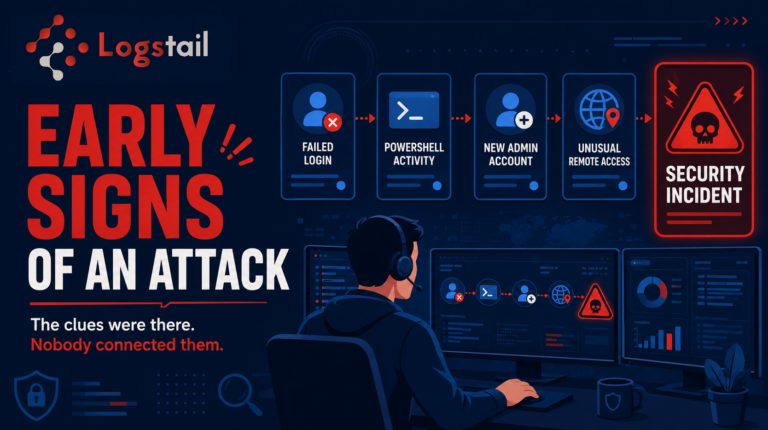
Instead, they often start with small indicators that appear harmless when viewed individually. A few failed login attempts, unusual PowerShell activity, a newly created administrator account, or a successful login from an unexpected location may not trigger immediate concern. Many organizations miss the early signs of a cyber-attack because individual events often appear harmless when viewed in isolation. The problem is that attackers understand how security teams operate. Rather than generating obvious alerts, they often move slowly, blend into legitimate activity, and rely on defenders treating events as isolated incidents instead of part of a larger attack.
For Security Operations Center (SOC) teams, identifying the early signs of a cyber-attack is often the difference between containing a threat and responding to a major security incident. Modern organizations already generate thousands of security events every day. Effective log management helps centralize this information. However, visibility alone is not enough. The real challenge is understanding which events matter and how seemingly unrelated activities may belong to the same attack timeline.
Most Attacks Leave Clues Before Impact
A common misconception is that cyberattacks happen suddenly. In reality, attackers rarely achieve their objective in a single step. Before data is stolen or ransomware is deployed, they typically establish access, explore the environment, escalate privileges, maintain persistence, and move laterally through systems. As a result, each stage of an attack generates telemetry. Authentication logs, endpoint events, privilege changes, and network activity can all provide valuable warning signs. However, these signals often appear across different systems and at different points in time. Viewed independently, they appear low risk. Viewed together, they can reveal an active compromise.
What Do the Early Signs of a Cyber Attack Look Like?
Attackers rarely start with obviously malicious behavior. Instead, they generate activity that can easily be mistaken for routine administrative tasks or normal user behavior.
Common examples include:
- Repeated failed login attempts
- Successful logins from unusual locations
- PowerShell execution outside normal activity patterns
- Creation of new local or domain administrator accounts
- Privilege escalation events
- Scheduled task creation
- Unusual remote access activity
- Unexpected outbound network connections
None of these events automatically indicate a compromise. However, when several indicators appear together, they often reveal a much bigger story. For example, a failed login followed by PowerShell activity may simply be a user mistake. On the other hand, a failed login followed by PowerShell activity, privilege escalation, and unusual data access deserves much closer attention.
Why SOC Teams Miss These Early Indicators
Too Many Alerts, Not Enough Context
Modern SOCs review large volumes of alerts every day. Authentication failures, endpoint detections, firewall events, cloud notifications, and application logs constantly compete for attention. Although alert volume can be overwhelming, the bigger challenge is understanding which alerts are connected. Without context, analysts can overlook activity that appears harmless but actually forms part of a progressing attack.
Security Data Lives in Multiple Places
Authentication activity, endpoint telemetry, firewall logs, cloud activity, and administrative events are often stored in separate tools. For example, an analyst may investigate a failed login in one platform without realizing that suspicious PowerShell activity occurred on the same account two days later in another platform. While the evidence often exists, the complete picture is rarely visible in a single location.
Events Are Investigated Individually
Many security tools generate separate alerts for separate activities. Authentication alerts remain in one dashboard. Endpoint alerts remain in another. Meanwhile, network events appear somewhere else. As a result, analysts spend valuable time stitching information together manually while attackers continue moving through the environment.
The Difference Between Noise and Meaningful Signals
Security teams often hear that “too much noise” is a problem. In reality, the issue is not having too many logs. The challenge is identifying meaningful signals within those logs.
Consider the following timeline:
Day 1 — Multiple failed login attempts against a user account.
Day 3 — Successful authentication from a previously unseen location.
Day 5 — PowerShell execution on a workstation.
Day 7 — Administrative privileges assigned to the account.
Day 10 — Large volumes of sensitive files accessed.
Each event appears relatively low risk when viewed independently. However, when viewed together, they reveal a potential compromise progressing through multiple stages of an attack. Consequently, correlation becomes critical. The early signs of a cyber-attack rarely appear as a single critical alert. More often, they emerge as multiple low-severity events spread across different systems and timeframes.
Organizations that rely on centralized security monitoring and log management are in a significantly better position to identify these relationships before an attacker reaches the final stages of an intrusion.
Reducing False Positives Through Better Detection
One of the largest contributors to analyst fatigue is false positives. Many alerts are technically accurate but provide little operational value. Consequently, analysts spend valuable time investigating isolated events that ultimately turn out to be benign. As alert volumes increase, the risk of overlooking genuine threats increases as well.
Modern SOC teams increasingly focus on:
- Detection tuning
- Risk-based alerting
- Behavioral analytics
- Event correlation
- Context enrichment
Rather than generating more alerts, organizations should focus on generating higher-quality alerts that provide meaningful context. Instead of receiving fifteen separate notifications, analysts should receive one investigation that combines related activities into a single incident.
The Logstail Security Suite is designed around this principle, helping security teams reduce noise and prioritize incidents based on context rather than isolated events.
How Logstail Turns Weak Signals into Actionable Investigations
The challenge is not finding a failed login, a PowerShell execution event, or a privilege escalation alert.
Most security tools can already do that. Instead, the challenge is understanding when those activities are related. This is where the Logstail Security Suite helps security teams identify the early signs of a cyber-attack before those indicators develop into a full-scale incident. Using Logstail SIEM, organizations can centralize logs from endpoints, Active Directory, firewalls, cloud platforms, identity providers, and other critical infrastructure components into a single platform. As a result, analysts gain visibility across the entire environment rather than manually pivoting between multiple consoles. Logstail then helps correlate related events into a single investigation timeline.
Rather than reviewing separate alerts, analysts can see:
- Authentication activity
- Endpoint activity
- Administrative changes
- User behavior
- Network activity
within the same investigation workflow.
This enables SOC teams to:
- Detect attack patterns earlier
- Reduce false positives
- Prioritize incidents more efficiently
- Accelerate investigations
- Improve analyst productivity
- Focus on high-risk activity
Furthermore, organizations looking to accelerate response actions can use Logstail SOAR to automate investigation and response workflows. Once predefined conditions are met, playbooks can isolate systems, notify stakeholders, create tickets, or trigger additional response actions automatically.
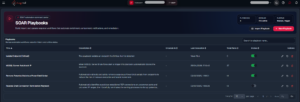
For example, Logstail SOAR can automatically isolate compromised endpoints, block malicious source IP addresses, remove suspicious PowerShell scripts, and terminate reverse shell connections. These actions help organizations respond quickly when early signs of a cyber-attack are detected. Instead of generating more noise, Logstail helps reduce it by transforming disconnected events into meaningful incidents.
Building Better Detection for Early Signs of a Cyber Attack
Organizations looking to improve early detection should focus on:
- Monitoring authentication activity
- Tracking privilege changes
- Collecting endpoint telemetry
- Enabling PowerShell logging
- Monitoring remote access activity
- Regularly tuning detections
- Reducing false positives
- Correlating security data across systems
Success is not measured by the amount of data collected. Instead, success is measured by how quickly security teams can identify and understand suspicious behavior. Ultimately, organizations that combine strong visibility, effective detection logic, and automated response capabilities are in a much stronger position to identify attacks before they become security incidents.
Conclusion
Most successful cyberattacks provide warning signs long before ransomware is deployed or sensitive data is stolen. The challenge is not whether those indicators exist. Rather, the challenge is recognizing them early enough to take action. By focusing on context, behavioral analysis, detection quality, and event correlation, SOC teams can identify attack activity earlier and respond more effectively. Recognizing the early signs of a cyber-attack allows organizations to reduce business impact, improve response times, and stop threats before attackers achieve their objectives. Platforms such as the Logstail Security Suite help organizations move beyond isolated alerts and fragmented visibility by correlating events, reducing false positives, and providing the context analysts need to understand the complete story behind suspicious activity.