
September 2, 2026
How AI Code Is Flooding the Web with Security Flaws
Introduction
Artificial intelligence has rapidly transformed the software development landscape. What once required hours of manual coding can now be completed in minutes with the assistance of AI-powered coding tools. Platforms such as GitHub Copilot, ChatGPT, Claude, Cursor, and Gemini Code Assist are helping developers generate code, automate repetitive tasks, write documentation, and accelerate software delivery at an unprecedented pace.
The productivity benefits are difficult to ignore. Development teams can move faster, reduce repetitive work, and focus more on solving business problems rather than writing boilerplate code. Organizations under constant pressure to release products more quickly often view AI coding assistants as a competitive advantage that improves efficiency and reduces time-to-market.
However, speed does not automatically translate into security.
While AI models can generate functional code, they do not truly understand software security, threat models, business logic, or the consequences of insecure coding practices. Instead, they generate code based on patterns learned from vast amounts of training data, which may include both secure and insecure examples.
As AI-generated code becomes increasingly common across web applications, APIs, cloud services, and enterprise software, security professionals are beginning to face a new challenge. Vulnerabilities that would normally be introduced by inexperienced developers are now being generated and copied at scale by AI tools, often without developers realizing the associated risks.
This raises an important question for developers, security teams, and organizations alike: How secure is AI-generated code?
In this article, we examine why AI-generated code presents unique security challenges, explore common vulnerabilities found in AI-assisted development, review real-world research findings, and explain how platforms such as Logstail SIEM and Logstail SOAR can help security teams identify and respond to risks introduced by AI-assisted coding.
Why AI-Generated Code Creates Security Risks
AI coding assistants have become powerful productivity tools, but they were not designed to function as security experts. Understanding why these systems introduce risk requires understanding how they generate code in the first place.
AI Generates Code Without Understanding Security
One of the most important misconceptions surrounding AI coding assistants is the belief that they “understand” the code they generate.
In reality, most AI models work by predicting the most probable sequence of tokens based on patterns observed during training. They do not understand application architecture, regulatory requirements, security policies, or threat models in the same way that experienced software engineers and security professionals do.
As a result, AI tools may generate code that appears technically correct while still introducing serious security weaknesses. A developer may receive a working authentication system, API endpoint, or database query that functions as expected but contains vulnerabilities that could later be exploited by attackers.
This creates a dangerous scenario where functionality is prioritized over security without the developer immediately recognizing the associated risk.
AI Learns From Insecure Examples
AI coding models are trained using enormous datasets that include publicly available code repositories, documentation, forums, and educational materials.
While this approach allows the models to learn programming patterns quickly, it also exposes them to insecure coding practices that have existed across the internet for years. Vulnerable code samples, outdated frameworks, insecure authentication mechanisms, and poor security practices can become part of the model’s training data.
When prompted to generate code, the model may reproduce those patterns because they statistically resemble examples it has seen before.
This means organizations cannot assume that AI-generated code automatically follows secure development principles, even if the generated output appears professional and well-structured.
Hallucinated Libraries and Dependencies
Another significant risk is the phenomenon commonly known as AI hallucination.
Developers often trust AI-generated recommendations for libraries, packages, APIs, and functions. However, AI systems occasionally invent packages that do not actually exist or reference dependencies that contain inaccurate documentation.
In some cases, attackers have already begun exploiting this behavior by registering fake packages that resemble hallucinated library names. If a developer installs one of these malicious packages, sensitive credentials, source code, or application data may be exposed.
This creates a potential software supply-chain risk where trusting AI-generated recommendations can inadvertently introduce malicious components into an organization’s development environment.
Insecure Default Implementations
AI-generated code frequently prioritizes simplicity and functionality rather than security hardening.
Developers may receive code that:
- Lacks proper input validation
- Uses weak encryption methods
- Stores sensitive information insecurely
- Fails to enforce authorization checks
- Exposes excessive error details
- Omits secure logging practices
While these implementations may function correctly during testing, they can create serious vulnerabilities once deployed to production environments.
Security issues introduced during development often become significantly more expensive and difficult to fix after deployment. As organizations increasingly rely on AI coding assistants, these insecure defaults have the potential to affect thousands of applications simultaneously.
The Scale Problem
Perhaps the greatest risk associated with AI-generated code is scale.
Traditionally, insecure code was introduced one developer at a time. Today, AI coding assistants can generate thousands of lines of code within minutes, multiplying the speed at which both secure and insecure patterns spread across software projects.
A single vulnerable code suggestion accepted by hundreds or thousands of developers can rapidly create widespread exposure across the software ecosystem.
This is why security teams are paying close attention to AI-assisted development. The challenge is no longer limited to identifying individual vulnerabilities. Organizations must now prepare for the possibility that insecure coding patterns can propagate across entire environments much faster than before.
Common Security Flaws Found in AI-Generated Code
While AI coding assistants can generate functional code remarkably quickly, researchers and security professionals have repeatedly observed that AI-generated code often contains many of the same vulnerabilities that have plagued software development for decades. The difference is that these vulnerabilities can now be produced and distributed at a much larger scale.
Security teams should view AI-generated code as code written by a junior developer: potentially useful, but always in need of validation, review, and testing before deployment.
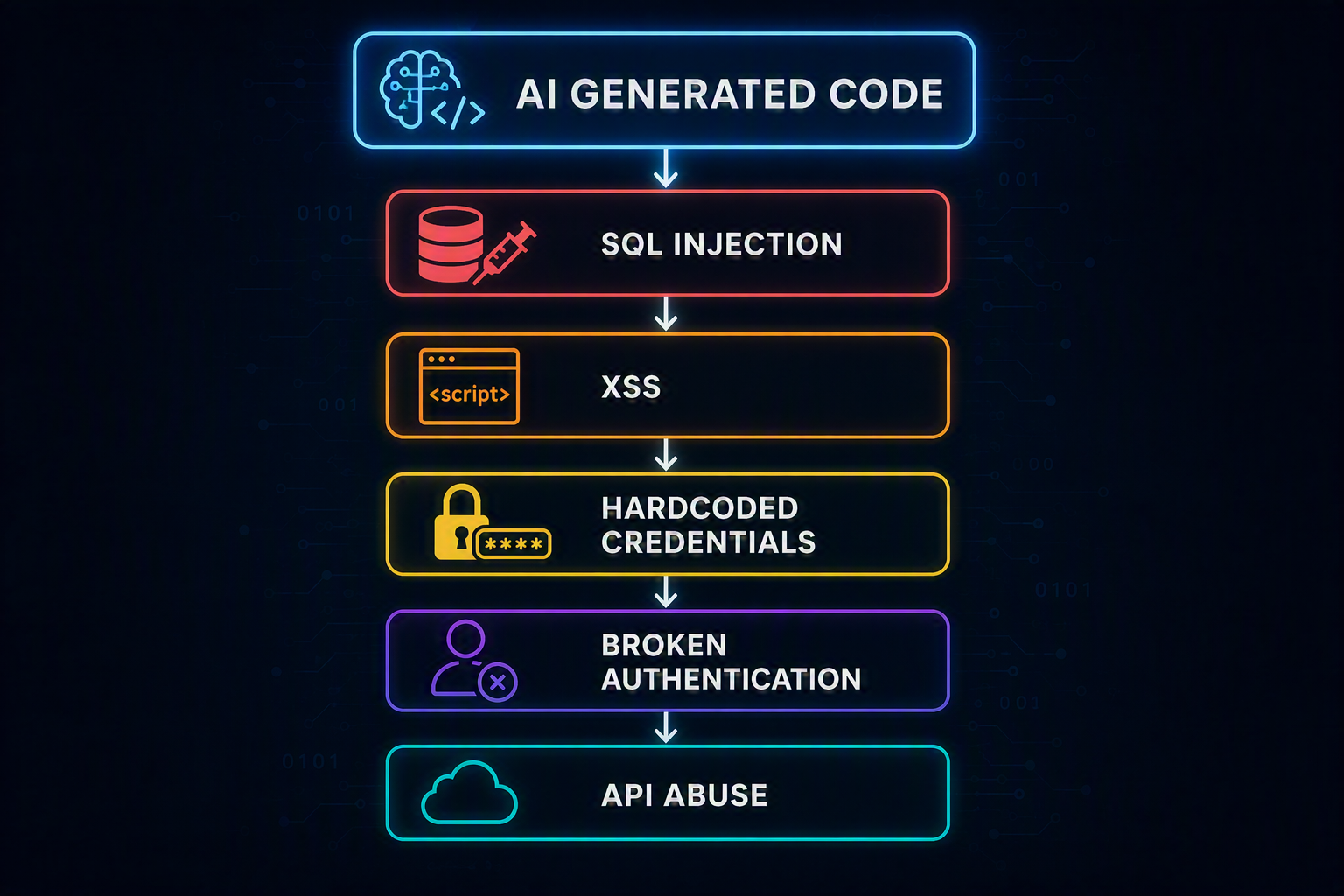
SQL Injection
SQL Injection remains one of the most common vulnerabilities found in web applications, and AI-generated code is not immune to the problem.
When developers ask an AI assistant to create a database query, the generated code may directly concatenate user input into SQL statements rather than using parameterized queries. While the code may function correctly during testing, it can allow attackers to manipulate database queries by injecting malicious input.
For example, an attacker may bypass authentication controls, retrieve sensitive information, modify records, or even delete entire databases if proper protections are not implemented.
Because many AI-generated code snippets prioritize simplicity over security, developers must carefully review database interactions and ensure that prepared statements and parameterized queries are consistently used throughout the application.
Cross-Site Scripting (XSS)
Cross-Site Scripting (XSS) vulnerabilities occur when applications fail to properly validate or sanitize user-supplied input before displaying it to other users.
AI-generated web application code can sometimes include insecure handling of form fields, search parameters, comments, or URL parameters. If user input is rendered directly in a browser without proper encoding, attackers may inject malicious JavaScript that executes in the victim’s session.
Successful XSS attacks can lead to account compromise, session hijacking, credential theft, and malicious content injection.
Although modern frameworks provide security protections against many XSS scenarios, developers should never assume that AI-generated code automatically follows secure output encoding practices.
Hardcoded Credentials
One of the most concerning issues frequently observed in AI-generated code is the inclusion of hardcoded credentials.Developers requesting sample code for API integrations, cloud services, authentication systems, or database connections may receive examples that include API keys, passwords, access tokens, or secret values directly within the source code.
While these examples are often presented as placeholders, developers may accidentally deploy them into production environments without implementing proper secret management controls.
Hardcoded credentials can significantly increase the risk of unauthorized access, privilege escalation, data exposure, and cloud account compromise.
Organizations should ensure that all secrets are managed through secure vaults, environment variables, or dedicated secrets-management platforms rather than being embedded directly into application code.
Broken Authentication
Authentication-related vulnerabilities represent another area where AI-generated code can introduce security risks.
When creating login functionality, session management components, or authentication workflows, AI assistants may generate implementations that lack important security controls such as:
- Multi-factor authentication support
- Strong password requirements
- Secure session management
- Account lockout protections
- Proper token validation
- Secure password storage
These weaknesses may allow attackers to bypass authentication mechanisms, hijack user sessions, or gain access to protected resources.
Authentication systems are among the most security-sensitive components of any application and should always undergo thorough security review regardless of whether they were written manually or generated by AI.
Insecure API Usage
Modern applications rely heavily on APIs for communication between services, cloud platforms, mobile applications, and third-party tools.
AI coding assistants frequently generate API integrations, but these implementations may omit important security mechanisms such as authentication validation, authorization checks, request throttling, encryption enforcement, or input validation.
As organizations increasingly expose APIs to customers and partners, insecure API implementations can become attractive targets for attackers seeking unauthorized access to sensitive systems and data.
Developers should ensure that AI-generated API code follows established security standards and organizational policies before deployment.
Insecure Deserialization
Insecure deserialization remains a highly dangerous vulnerability that can lead to remote code execution and system compromise.
Applications often serialize objects to transfer data between systems or store information for later processing. If applications deserialize untrusted input without proper validation, attackers may manipulate serialized objects to execute malicious code or gain unauthorized access to system resources.
AI-generated code may sometimes include serialization mechanisms without implementing the necessary security controls required to safely process untrusted data.
Although developers may not encounter this vulnerability as frequently as SQL injection or XSS, its impact can be significantly more severe when successfully exploited.
The Security Challenge of Scale
What makes AI-generated vulnerabilities particularly concerning is not simply the existence of these flaws, but the speed at which they can spread.
A vulnerable code pattern suggested by an AI assistant can be copied into countless repositories, applications, and development projects within a very short period of time. As adoption of AI coding assistants continues to grow, organizations must recognize that vulnerabilities can now be introduced faster than ever before.
For this reason, AI-generated code should never bypass traditional security processes. Secure code reviews, automated scanning tools, vulnerability assessments, and security testing remain essential components of a secure software development lifecycle, regardless of how the code was created.
The Hidden Security Risks Behind AI-Generated Code
The biggest misconception about AI coding assistants is that they understand security. In reality, AI models do not reason about cybersecurity in the same way experienced developers or security engineers do. Their primary function is to predict the next most likely piece of code based on patterns learned during training. While this often produces functional code, it does not guarantee that the code follows secure development practices.
Another challenge is the quality of the data used to train these models. AI systems learn from massive collections of publicly available code, documentation, tutorials, and open-source repositories. While many of these sources contain high-quality examples, others include outdated practices, vulnerable code, misconfigurations, and insecure implementations. As a result, an AI assistant may reproduce insecure coding techniques that already exist within its training data.
Organizations must also consider the problem of AI hallucinations. In software development, hallucinations can appear as non-existent libraries, imaginary functions, unsupported APIs, or incorrect implementation guidance. Developers who trust these outputs without verification can unintentionally introduce security weaknesses, reliability issues, or dependency risks into production systems.
In many cases, AI coding assistants also prioritize functionality over security. A generated solution may achieve the intended result while ignoring input validation, access control requirements, cryptographic best practices, or secure authentication mechanisms. The application works, but the security of the implementation is often left to the developer to validate.
The result is a growing challenge for organizations adopting AI-assisted development. While developers become more productive, security teams must ensure that vulnerabilities are not being introduced faster than they can be identified and remediated. Effective code review, security testing, and continuous monitoring remain critical parts of the software development lifecycle, even when AI tools are involved.
Real-World Studies on AI Code Security
Why Developers Miss AI Security Issues
Trust in AI Output
Many developers assume AI-generated code is correct because it appears professionally written and produces the expected functionality. This false sense of confidence often reduces scrutiny during code reviews.
Pressure to Deliver Faster
Organizations increasingly adopt AI tools to accelerate development cycles. Under tight deadlines, developers may focus on functionality rather than security validation.
Security Knowledge Gaps
Not every developer has extensive security expertise. AI-generated vulnerabilities may appear harmless until exploited by an attacker.
Lack of Secure Prompting
Most prompts focus on making code work rather than making code secure. Security requirements are often omitted entirely during generation.
How Attackers Can Exploit AI-Generated Code
Attackers continuously scan public repositories and exposed applications for common mistakes.
When vulnerable AI-generated code reaches production environments, attackers can potentially:
- Steal sensitive data
- Gain unauthorized access
- Escalate privileges
- Execute malicious code
- Deploy ransomware
- Move laterally across environments
The risk increases when the same insecure coding patterns are replicated across multiple projects generated by AI tools.
How Organizations Can Reduce AI Coding Risks
Implement Secure Code Reviews
Every AI-generated code submission should undergo human review before deployment. Security reviews help identify dangerous logic that automated generation tools may introduce.
Use SAST and DAST Tools
Static Application Security Testing (SAST) and Dynamic Application Security Testing (DAST) solutions can identify vulnerabilities during development and testing phases.
Apply DevSecOps Practices
Security should be integrated throughout the development lifecycle. Automated controls, validation procedures, and secure deployment pipelines help reduce AI-related risks.
Validate Third-Party Dependencies
Organizations should monitor dependencies for vulnerabilities and regularly update software components used by applications.
Train Developers on AI Security Risks
Developers must understand both the strengths and limitations of AI coding assistants. Proper training helps teams use AI effectively while maintaining secure development practices.
How SIEM and SOAR Help Detect AI-Generated Vulnerabilities
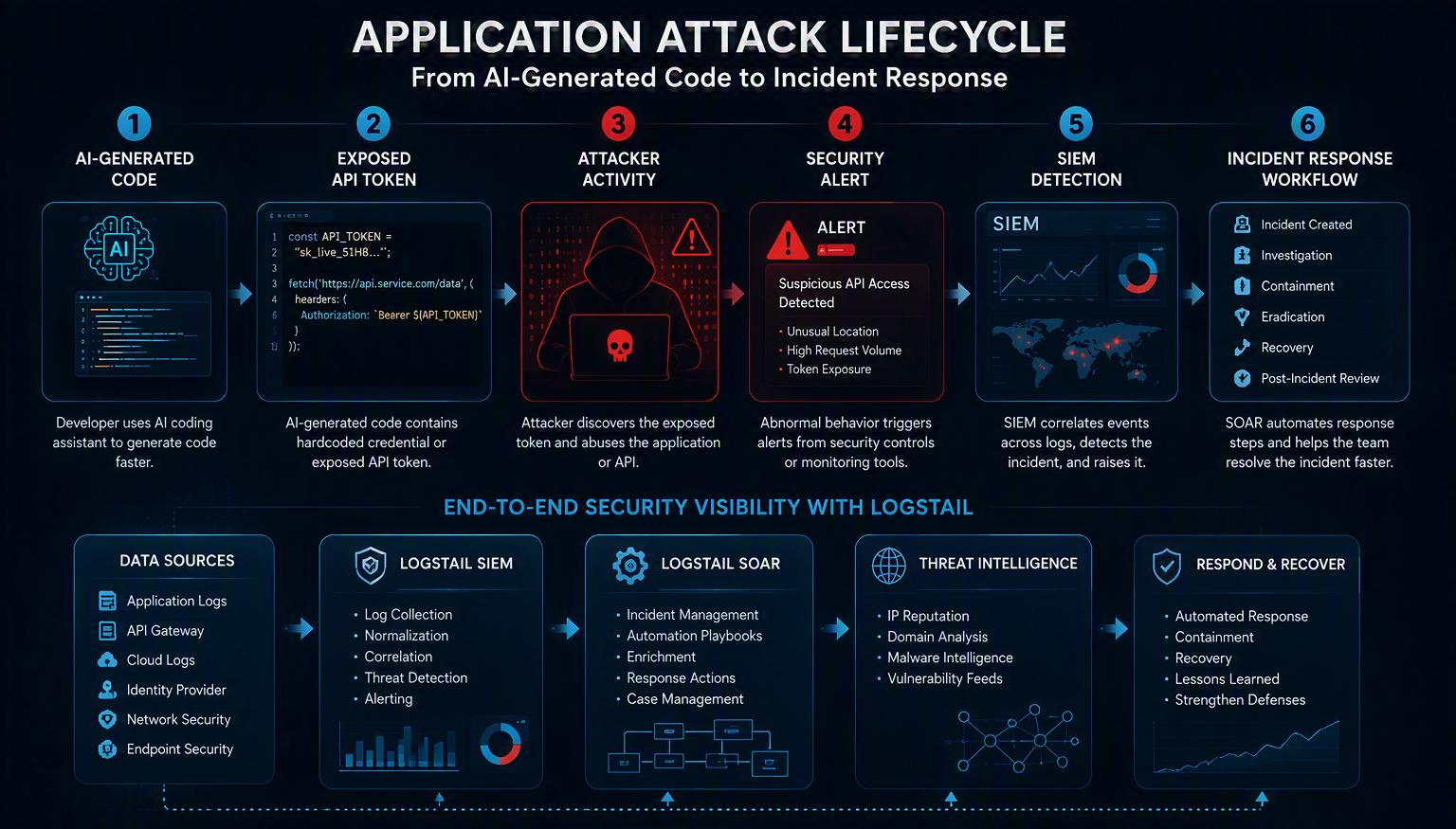
Preventing vulnerabilities is only part of the solution. Organizations must also detect attacks targeting vulnerable applications.
Through centralized monitoring, SIEM solutions help security teams identify suspicious application behavior, unauthorized access attempts, unusual API activity, and indicators of compromise.
SOAR platforms further enhance response capabilities by automating investigation workflows, collecting threat intelligence, and accelerating incident response processes.
Together, SIEM and SOAR technologies help organizations reduce the operational impact of software vulnerabilities, regardless of whether those vulnerabilities originated from human-written or AI-generated code.
How Logstail Helps Security Teams Monitor Application Risks
Logstail SIEM provides centralized visibility across applications, cloud environments, endpoints, identities, and network infrastructure.
By aggregating security telemetry from multiple sources, analysts can identify abnormal application behavior, suspicious authentication activity, access anomalies, and potential exploitation attempts associated with vulnerable software.
Security teams can use Logstail SIEM to:
- Centralize application monitoring
- Correlate security events
- Detect anomalous behavior
- Investigate incidents faster
- Improve threat visibility
Beyond monitoring, Logstail SOAR enables organizations to automate repetitive response activities, enrich alerts with contextual intelligence, and streamline investigation workflows.
How Logstail Academy Helps Security Teams Address AI Security Risks
Technology alone is not enough to manage emerging AI-related risks.
Through Logstail Academy, security professionals can strengthen their understanding of threat detection, incident response, security monitoring, and investigation methodologies.
As AI-generated code becomes increasingly common, defenders must develop the skills necessary to identify application-focused attack techniques and respond effectively when vulnerabilities are exploited.
Logstail Academy provides practical training that helps analysts transform security data into actionable intelligence and improve their ability to detect modern threats.
Security risks introduced through AI-generated code highlight the importance of secure coding practices. Through Logstail Academy’s Secure Coding Mastery: React, Node and Beyond learning path, developers can strengthen their understanding of secure development principles, secure authentication, input validation, API security, and modern application security best practices.

Real-World Example
Imagine a developer using an AI assistant to build a customer portal. The generated code successfully handles user authentication and database queries, but a hidden SQL injection vulnerability remains in a search function.
Months later, an attacker discovers the flaw and begins extracting sensitive records from the application’s database.
Without centralized monitoring, the activity may appear legitimate.
However, when application logs, authentication events, network activity, and database telemetry are integrated into Logstail SIEM, analysts can correlate unusual query patterns, suspicious access behavior, and abnormal data transfers to identify the attack quickly.
Combined with Logstail SOAR, response actions can be automated to accelerate containment and investigation efforts.
Key Takeaways
AI coding assistants are transforming software development, but they are also introducing new security risks.
Organizations should treat AI-generated code as a productivity tool rather than a trusted security authority. Every generated output should undergo proper review, validation, and testing before deployment.
By combining secure development practices, continuous monitoring, security automation, and ongoing training, organizations can benefit from AI-driven development while reducing exposure to software vulnerabilities.