
September 15, 2026
How to Implement Least Privilege in Your Organization: A Practical Guide
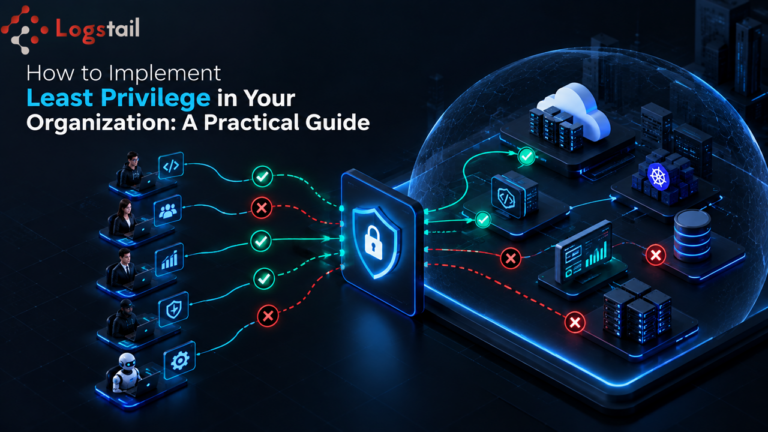
The Principle of Least Privilege is one of the most fundamental ideas in cybersecurity. The concept is straightforward: users, applications, services, and systems should only have the access they need to perform their responsibilities, and nothing more.
In practice, however, implementing least privilege across an organization can be surprisingly difficult.
Employees change roles, developers require temporary production access, administrators need elevated permissions, and applications often rely on service accounts with broad access. Over time, permissions accumulate. Access that was granted temporarily becomes permanent, unused accounts remain active, and privileges slowly expand far beyond what is actually necessary.
This gradual accumulation of unnecessary access is often referred to as privilege creep, and it can significantly increase the impact of a successful attack.
A mature least-privilege strategy is therefore not simply about assigning the correct permissions once. It requires continuous visibility, regular reviews, strong identity governance, effective monitoring, and automation.
In this guide, we will explore how organizations can implement least privilege in a practical way, including Role-Based Access Control, administrative account separation, service account security, Just-in-Time access, access reviews, monitoring, and automation. We will also look at how Logstail Academy, Logstail SIEM & SOAR, and Logstail EASM can support this strategy.
What Is the Principle of Least Privilege?
The Principle of Least Privilege, commonly known as PoLP, means that an identity should receive only the permissions required to perform its assigned function.
That identity does not necessarily have to be a person. In modern environments, identities can include employees, administrators, contractors, applications, APIs, service accounts, containers, CI/CD pipelines, cloud workloads, and automation tools.
For example, a member of the finance department may need access to invoices, financial reports, and payment workflows. That does not mean the same user should be able to create administrator accounts, modify firewall policies, access application source code, or disable security monitoring.
The purpose of least privilege is not to make people’s jobs harder. It is to reduce the amount of damage that can occur when an account or system is compromised.
If a standard employee account is compromised, an attacker should not automatically gain administrative access to the entire environment. Similarly, if a web application is exploited, the associated service account should not provide unrestricted access to databases, cloud infrastructure, or sensitive internal resources.
Least privilege creates boundaries around what each identity can do.
Start With Visibility Into Existing Access
Before reducing privileges, an organization first needs to understand what access currently exists.
This can be more challenging than it sounds, especially in mature environments where identity systems, cloud providers, SaaS applications, internal systems, and legacy infrastructure all maintain their own permission models.
The first step should be to inventory both human and non-human identities. Human identities include employees, administrators, contractors, temporary users, and external partners. Non-human identities include service accounts, application accounts, cloud IAM roles, API credentials, database accounts, CI/CD identities, and automation accounts.
For each identity, the organization should be able to answer four basic questions: what does this identity have access to, why does it require that access, who owns the identity, and when was that access last reviewed?
If the answer to any of those questions is unclear, the access should be investigated.
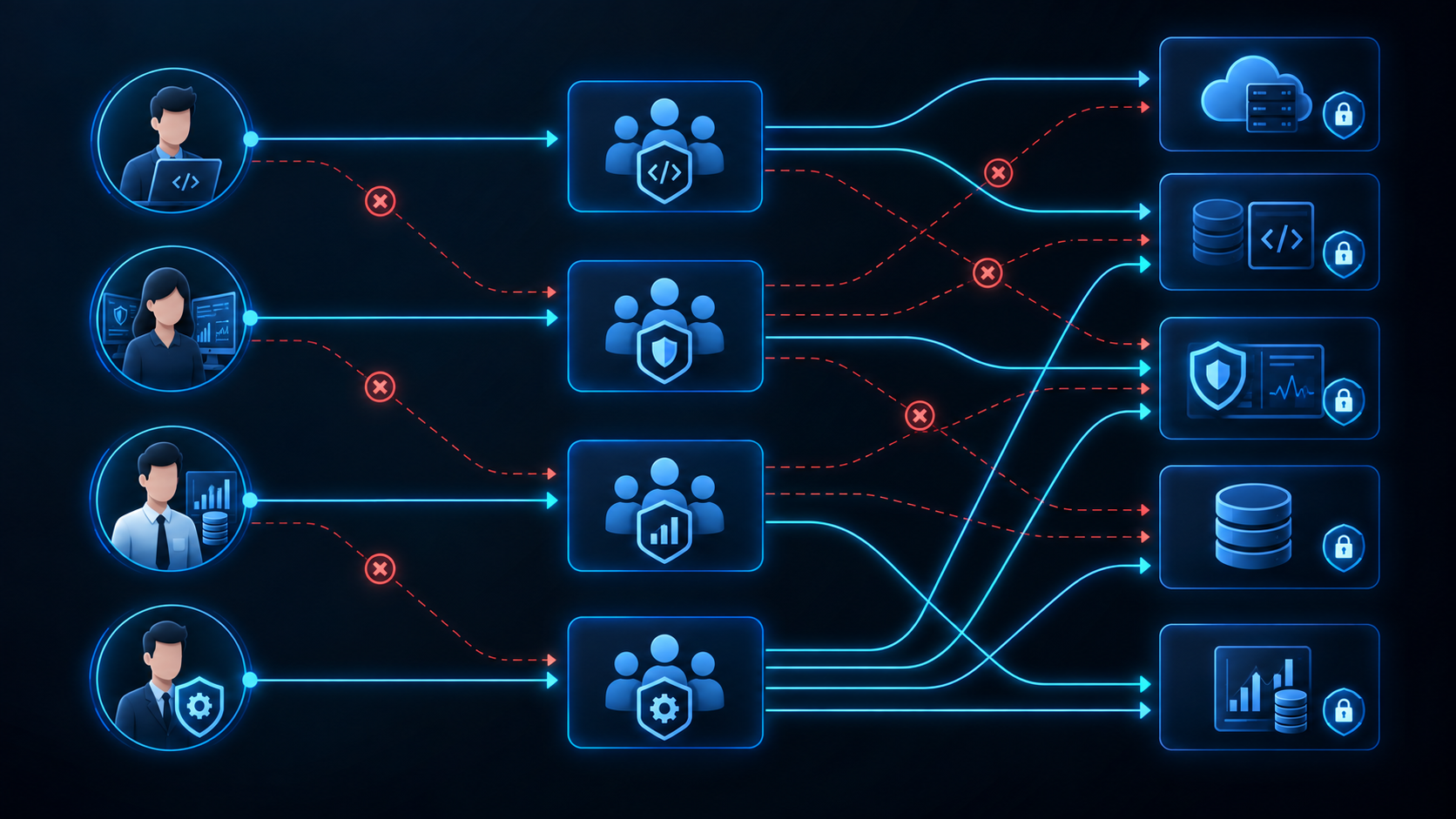
A simple access matrix can be useful during this process. For example, a developer may require read and write access to source code repositories but may not require permanent access to production databases. A SOC analyst may need access to security logs and investigation tools but should not necessarily be able to modify organization-wide identity policies.
The purpose of this exercise is to establish a clear picture of what access is required before attempting to redesign the permission model.
Use Role-Based Access Control
One of the most effective ways to implement least privilege is through Role-Based Access Control, or RBAC.
Without RBAC, organizations often assign permissions directly to individual users. This approach becomes difficult to manage very quickly. Every time someone changes position, joins a project, leaves a department, or receives additional responsibilities, administrators have to manually update multiple permissions.
Over time, these direct assignments become difficult to track and even harder to remove.
RBAC solves this by grouping permissions into roles that represent specific responsibilities.
Instead of assigning permissions directly to an individual employee, the organization assigns that employee to a role such as Helpdesk Technician, SOC Analyst, Finance User, or Cloud Administrator. The permissions are attached to the role rather than the person.
A Helpdesk Technician, for example, may be allowed to reset passwords, unlock user accounts, and view endpoint information. That same role should not automatically include the ability to create global administrators or modify security policies.
Similarly, a SOC Analyst may need permission to search logs, investigate alerts, review endpoint telemetry, and manage security cases. They may not need permission to disable log collection or modify production infrastructure.
This makes access easier to manage because when an employee changes roles, administrators can remove the old role and assign the appropriate new one.
However, RBAC should not become overly complicated. Organizations sometimes create hundreds of extremely specific roles that are difficult to understand and maintain. Roles should be based on recognizable operational or business responsibilities rather than every possible combination of permissions.
A good RBAC model should make access simpler, not introduce another layer of complexity.
Separate Administrative Accounts From Daily User Accounts
Administrative accounts are among the most valuable targets for attackers because they provide elevated access to critical systems.
One common mistake is allowing administrators to perform normal daily activities using privileged accounts.
An administrator who reads email, browses the web, downloads files, and joins meetings using the same account that manages production infrastructure increases the exposure of privileged credentials.
A better approach is to separate standard and privileged identities.
An administrator may use a standard corporate account for everyday tasks such as email, collaboration, documentation, and web browsing. A separate privileged identity can then be used specifically for administrative tasks.
This creates a cleaner security boundary and also improves monitoring.
If an administrative account is only used for privileged activities, unexpected behavior becomes easier to detect. For example, if a privileged account suddenly begins accessing unrelated applications or authenticating from unusual systems, security teams can investigate more quickly.
Privileged identities should also receive stronger controls than ordinary user accounts. Phishing-resistant MFA, restricted login locations, shorter session durations, conditional access policies, additional logging, and dedicated administrative workstations can significantly reduce risk.
The goal is to minimize both the number of privileged accounts and the amount of time those accounts are actively used.
Secure Service Accounts and Machine Identities
Least privilege applies to machines just as much as it applies to people.
Modern infrastructure contains a growing number of non-human identities. Monitoring tools, backup systems, web applications, cloud workloads, Kubernetes services, CI/CD pipelines, automation platforms, and integrations all need credentials and permissions to operate.
These identities can become particularly dangerous because they are often created for technical convenience.
During troubleshooting, an engineer might temporarily grant a service account broad administrative permissions so that an application can function correctly. Once the issue is resolved, those permissions may never be removed.
This can result in service accounts holding far more access than they actually require.
For example, an application that only needs to read files from a single storage location should not receive full administrative access to an entire cloud storage environment. A CI/CD pipeline that deploys one application should not automatically receive ownership permissions across an entire subscription.
Every service account should have a defined purpose and a clear owner. Its permissions should be limited to the resources it actually requires, and its credentials should be protected using an appropriate secrets-management solution.
Organizations should also avoid long-lived credentials whenever possible. Secrets, tokens, and API keys should be rotated regularly, and service account activity should be monitored just like human user activity.
When applications are retired, their associated service accounts should be removed as well.
An unidentified service account with administrative permissions is not just an operational problem. It is a security risk.
Replace Standing Privilege With Just-in-Time Access
Another important step toward least privilege is reducing permanent administrative access.
Consider a developer who needs access to production systems only a few times per month. If that developer has permanent administrator permissions, those privileges remain available at all times, even when they are not being used.
This unnecessarily expands the attack surface.
Just-in-Time, or JIT, access provides a better model.
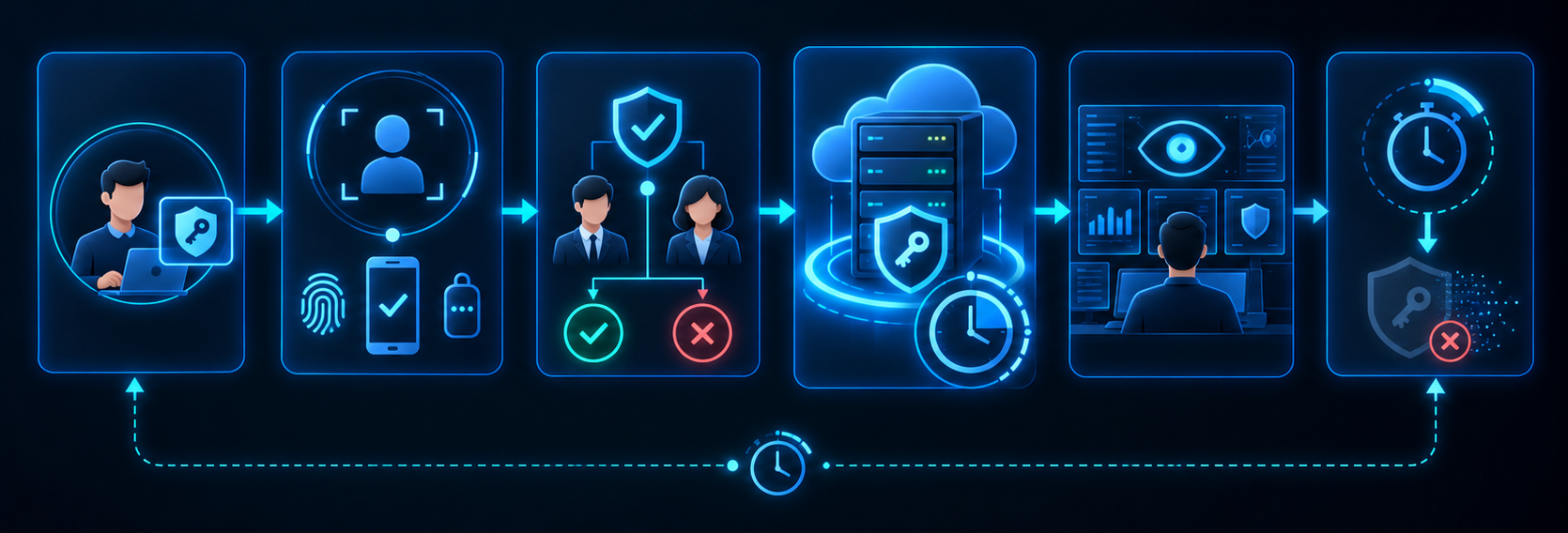
Instead of permanently assigning elevated permissions, the user requests access when it is required. The request can include a business justification, ticket number, or approval from a manager or security team. Once approved, the user receives the required permissions for a limited period.
After the specified time expires, those privileges are automatically removed.
A developer might therefore receive database administrator access for one hour rather than permanently maintaining that role.
The strongest implementation combines Just-in-Time access with the concept of Just Enough Access.
Just-in-Time determines when a user receives elevated permissions.
Just Enough Access determines how much permission they receive.
Instead of granting broad administrative access, the organization might provide only the specific permissions required to restart a service or modify a particular application.
This significantly reduces the potential impact of compromised credentials.
Perform Regular Access Reviews
Even well-designed access models become outdated.
Organizations constantly change. Employees move between departments, responsibilities shift, projects end, contractors leave, and new applications are introduced.
If permissions are continuously added but rarely removed, privilege creep becomes inevitable.
Access reviews should therefore be part of the organization’s normal security governance process.
During a review, managers and system owners should evaluate whether users still require the permissions they currently hold. This is especially important for privileged accounts, production systems, sensitive data, cloud resources, and external contractors.
The key question should not simply be whether the user still works for the organization.
The question should be whether the user still needs each individual permission to perform their current responsibilities.
Access reviews can be performed quarterly, every six months, after an employee changes roles, when a contractor engagement ends, or following major organizational changes.
High-risk permissions may require more frequent review.
The goal is to treat access as something that must be continuously justified rather than something that remains indefinitely once granted.
Monitor Privileged Activity
Least privilege cannot rely entirely on preventive controls.
Even correctly configured privileged accounts can still be compromised or misused.
This means organizations need visibility into how privileged identities behave.
Authentication events, role assignments, permission changes, service account activity, administrative logins, security policy modifications, and privileged operations should all generate security telemetry.
A centralized security monitoring platform can help security teams identify patterns that may indicate suspicious behavior.
For example, a service account that normally performs automated API calls should not suddenly begin logging into systems interactively.
Similarly, an administrator who normally works during business hours may warrant investigation if their account starts changing permissions in the middle of the night.
Other suspicious patterns can include the sudden creation of new administrator accounts, multiple privileged role assignments within a short period, unexpected API credential generation, or attempts to disable security controls.
Monitoring becomes especially valuable when combined with contextual information.
A single administrator login may be normal. An administrator login from an unusual location followed by privilege escalation and large data transfers is much more concerning.
Least privilege limits what an identity can do. Monitoring helps identify when someone is attempting to abuse or exceed those boundaries.
Automate Access and Response Where Possible
Manual access management is difficult to maintain at scale.
When access processes are slow or inconvenient, employees may attempt to work around them. This can result in shared accounts, permanent privileges, or unofficial processes that increase security risk.
Automation can make least privilege more practical.
For example, employee onboarding can automatically create an identity and assign the appropriate role based on the employee’s department or job function.
When an employee changes roles, old permissions can be automatically removed before new ones are assigned.
During offboarding, automation can disable the account, revoke active sessions, remove privileged memberships, and flag associated API credentials for review.
JIT access can also be automated so that temporary privileges are granted only after approval and are automatically revoked once the access window expires.
Security response can follow the same model.
If suspicious privileged activity is detected, an automated workflow might generate an alert, enrich the event with identity context, notify the security team, create an investigation case, and potentially revoke sessions or disable the account depending on the organization’s response policies.
However, automation itself must also follow least privilege.
A SOAR integration that only needs to disable user accounts should not receive unrestricted administrative access to the entire identity platform.
Security automation should reduce risk, not become another source of excessive privilege.
Least Privilege Also Applies to External Exposure
Least privilege is usually discussed in the context of identity and access management, but the underlying principle can also be applied to infrastructure exposure.
An organization may have systems or services exposed to the internet that were never intended to be publicly accessible.
Examples include administrative dashboards, remote management interfaces, development environments, staging applications, databases, and forgotten cloud services.
These exposed systems increase the organization’s attack surface.
The same logic behind least privilege applies here: only expose what is necessary.
If an administrative interface only needs to be accessible internally, it should not be reachable from the public internet.
If a service is no longer required, it should be removed.
If a development environment does not need external access, that exposure should be restricted.
Reducing unnecessary external exposure can significantly decrease the number of opportunities available to attackers.
Common Least-Privilege Mistakes
One of the most common mistakes is assuming that read-only access is harmless.
Read permissions can still expose source code, infrastructure configuration, customer information, security logs, internal documentation, or credentials embedded in poorly managed files.
Least privilege should therefore apply to both read and write access.
Another frequent mistake is leaving administrative permissions active permanently. A user may receive elevated access for a specific project or troubleshooting task, but the privilege remains long after the original requirement has disappeared.
Shared administrative accounts are another major problem because they make accountability difficult. If multiple administrators use the same account, security teams may be unable to determine who performed a specific action.
Service accounts can create similar challenges. They are often overlooked during access reviews, even though some of them hold extremely powerful permissions.
Organizations should also remember that role names do not always represent actual privilege.
An account may not be labelled “Administrator” but could still modify privileged automation pipelines, reset administrative passwords, assign cloud IAM roles, or access credentials belonging to other systems.
Effective privilege matters more than the title assigned to the account.
A Practical Least-Privilege Implementation Roadmap
Organizations do not need to redesign their entire access architecture overnight.
A phased approach is usually more practical.
The first phase should focus on discovery. Identify users, administrators, service accounts, cloud identities, sensitive applications, external systems, and privileged roles. Determine who owns these identities and understand how they are currently being used.
Once the environment is understood, the organization can begin reducing unnecessary access. Dormant accounts can be disabled, obsolete administrator permissions can be removed, unused service accounts can be investigated, and unnecessary public exposure can be restricted.
The next stage is standardization.
Organizations can introduce RBAC, administrative account separation, MFA requirements, service-account standards, credential-management policies, and consistent joiner-mover-leaver procedures.
After the basic access model is stable, high-risk privileges can gradually move toward Just-in-Time access.
Production administrators, cloud administrators, database administrators, and other highly privileged roles are good candidates for temporary elevation rather than permanent access.
Monitoring should then be integrated across authentication, role assignments, service-account activity, permission changes, and administrative actions.
Finally, mature organizations can automate access provisioning, expiration, monitoring, investigation, and response.
The goal is not to implement every control at once.
The goal is to continuously reduce unnecessary privilege while making access easier to manage and easier to audit.
How Logstail Can Support a Least-Privilege Strategy
Least privilege works best when organizations combine identity controls with training, monitoring, automation, and external visibility.
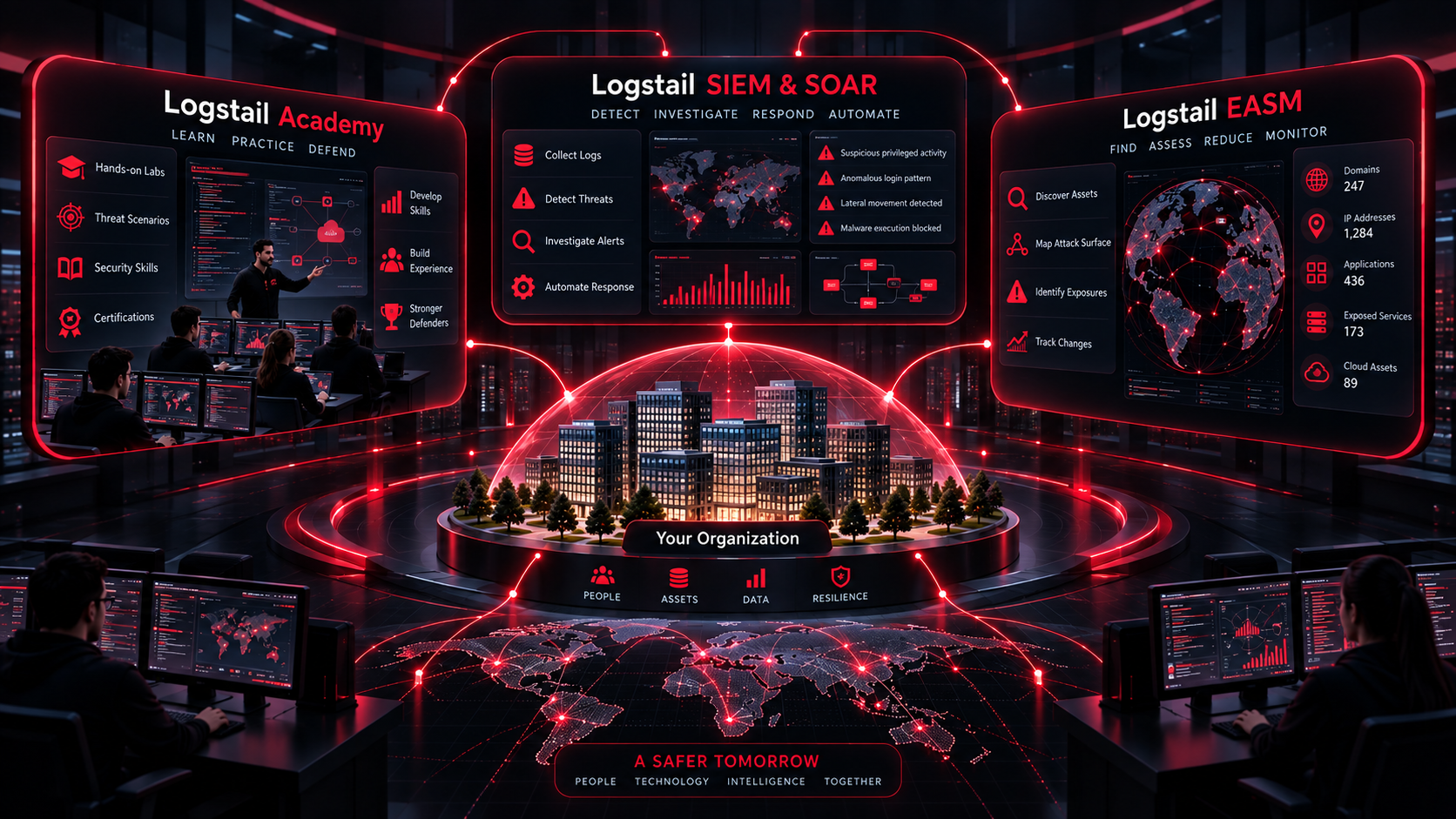
The different parts of the Logstail ecosystem can contribute to these areas.
Logstail Academy: Building the Skills Behind Least Privilege
Technology alone cannot enforce a strong security culture.
Administrators, SOC analysts, developers, and security engineers need to understand how access controls work, why privilege should be limited, and how suspicious behavior should be investigated.
Logstail Academy can support this through structured cybersecurity learning and practical exercises.
Security teams can use training to reinforce topics such as identity security, privileged account management, access controls, SIEM monitoring, incident response, and secure administration.
Hands-on learning is particularly useful because it allows security professionals to move beyond theoretical understanding.
Instead of simply reading about privileged access monitoring, analysts can practice investigating suspicious authentication events, reviewing security telemetry, and responding to incidents in controlled environments.
This helps organizations turn policy into operational capability.
Logstail SIEM & SOAR: Monitoring and Responding to Privileged Activity
A least-privilege strategy also depends on visibility.
Organizations need to know when privileged accounts authenticate, when permissions change, when administrative roles are assigned, and when service accounts behave unexpectedly.
Logstail SIEM & SOAR can help centralize and analyze security telemetry from across the environment.
Authentication logs, administrative actions, endpoint telemetry, identity events, and application activity can be collected and correlated to provide a clearer picture of privileged behavior.
For example, a SOC team could investigate unusual administrator authentication, unexpected role assignments, abnormal service-account activity, or attempts to change security settings.
Once suspicious behavior is detected, Logstail SOAR can help automate parts of the response workflow.
A suspicious privileged login might generate an alert, create an investigation case, enrich the event with additional context, notify the security team, and trigger approved response actions through integrations.
This can make privileged-access monitoring more consistent and reduce the amount of repetitive manual work required during investigations.
The integrations themselves should also follow least privilege.
If an automated workflow only needs permission to disable an account, it should not receive broader administrative access than necessary.
Logstail EASM: Reducing Unnecessary External Exposure
Least privilege should not stop at identities.
Organizations should also apply similar thinking to their external attack surface.
Logstail EASM can help identify internet-facing assets such as domains, subdomains, public IP addresses, web applications, services, and other externally reachable infrastructure.
This visibility can help security teams identify systems that may be exposed unnecessarily.
For example, an organization might discover an administrative interface reachable from the public internet, an outdated staging environment, or a forgotten service running on a public IP address.
These systems may not involve excessive identity permissions directly, but they represent unnecessary access from an external perspective.
The security principle is effectively the same.
If a user does not require a permission, remove it.
If a service does not require internet exposure, remove or restrict that exposure.
By reducing both excessive privilege and unnecessary external exposure, organizations reduce the number of paths attackers can use to move deeper into the environment.
Bringing It All Together
Least privilege should not be treated as a one-time IAM project.
It is an ongoing security process that touches identity management, infrastructure, cloud environments, application security, monitoring, automation, and organizational governance.
A successful least-privilege program starts with understanding who and what has access.
From there, organizations can introduce RBAC, separate administrative identities, secure service accounts, reduce standing privileges, implement Just-in-Time access, and perform regular access reviews.
Monitoring provides visibility into how privileged identities are actually being used, while automation helps ensure that access is granted and removed consistently.
External attack-surface management adds another layer by identifying systems and services that may be unnecessarily exposed to the internet.
Together, these controls help organizations move toward a security model where access is intentional, limited, observable, and temporary whenever possible.
This matters because security incidents are rarely determined by whether an attacker gains initial access.
What often matters more is what that compromised identity can do next.
A compromised account with minimal permissions may result in a contained incident.
A compromised account with excessive privilege can become the starting point for organization-wide compromise.
Least privilege helps make sure the difference works in your favor.
Strengthen Your Security Operations With Logstail
Implementing least privilege requires more than restricting permissions.
Organizations also need skilled security teams, centralized visibility, automated response capabilities, and a clear understanding of their external attack surface.
Logstail Academy can help teams develop practical cybersecurity skills.
Logstail SIEM & SOAR can help organizations monitor privileged activity, investigate suspicious events, and automate security response workflows.
Logstail EASM can help identify externally exposed systems and reduce unnecessary attack surface.
Together, these capabilities can support a broader security strategy focused on reducing unnecessary access, improving visibility, and responding faster when suspicious activity occurs.
The objective is simple:
Give identities only the access they need, for only as long as they need it, and maintain enough visibility to know when that access is being abused.