
October 19, 2026
When Smart Factories Expand the Attack Surface: The Security Trade-Offs of Industry 4.0
Introduction
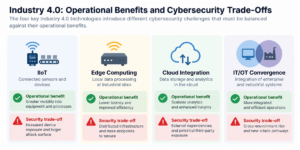
Industry 4.0 is transforming industrial environments through increased connectivity and advanced digital technologies. Systems that once operated separately now exchange data across industrial and enterprise networks. Technologies such as the Industrial Internet of Things (IIoT), edge computing, and cloud platforms support this transformation. They help organisations monitor production processes, improve efficiency, and make better operational decisions.
Connected sensors support predictive maintenance, while cloud analytics can improve production planning. Remote access also allows engineers to troubleshoot equipment without visiting industrial facilities. However, these capabilities introduce new cybersecurity challenges as previously isolated systems become increasingly interconnected.
Every additional device, service, or communication pathway can expand the industrial attack surface. Industrial systems now exchange information with enterprise applications, cloud platforms, and external technology providers. As a result, cybersecurity risks extend beyond individual assets and affect the wider industrial environment.
This raises an important question: How can organisations benefit from Industry 4.0 without compromising operational safety, reliability, and continuity? Addressing this challenge requires a clear understanding of system dependencies, cybersecurity exposure, and operational requirements.
Industry 4.0 Cybersecurity: Understanding the Expanding Attack Surface
Traditional industrial control systems were designed to manage physical processes. Their main priorities were availability, reliability, and safety rather than external connectivity. Programmable Logic Controllers (PLCs), Supervisory Control and Data Acquisition (SCADA) systems, Human-Machine Interfaces (HMIs), and engineering workstations were commonly deployed within dedicated industrial networks. Although these environments were not inherently secure, their comparatively limited connectivity often reduced the number of external access pathways available to potential attackers.
Industry 4.0 is changing this model by introducing communication between industrial assets, enterprise infrastructure, cloud services, and external technology providers. A manufacturing facility may collect data from hundreds of connected sensors. Industrial gateways process this information and transmit selected data to cloud platforms. Equipment vendors may also access systems remotely for maintenance. These capabilities support more efficient and informed operations, but they also establish additional trust relationships and potential attack paths.
![Industry 4.0 and the Expanding Industrial Attack Surface]](https://content.logstail.com/wp-content/uploads/2026/10/477e3a93-fa8a-4f9b-85fa-ce71cd72aaee-300x169.png)
The NIST Guide to Operational Technology Security (SP 800-82 Rev. 3) highlights the unique requirements of OT systems. These include performance, reliability, and safety. NIST also emphasises the need to adapt cybersecurity measures to industrial operating conditions.
This becomes particularly relevant when industrial devices interact with external systems that may follow different security practices, maintenance schedules, and operational responsibilities.
The real challenge is not simply the number of connected assets, but the growing complexity of the relationships between them.
A vulnerability affecting an industrial gateway, a compromised remote access account, or an improperly configured cloud integration may create opportunities for attackers to reach systems that were previously less exposed. Consequently, organisations must consider the broader architecture of their industrial environments rather than evaluating cybersecurity risks exclusively at the device level.
Trade-Off 1: IIoT Visibility Versus Device Exposure
IIoT technologies enable organisations to collect operational information from industrial equipment and physical processes. Connected sensors monitor vibration, temperature, pressure, and equipment performance. This information helps organisations identify anomalies, improve maintenance, and reduce unexpected downtime. By providing continuous visibility into industrial operations, these technologies support more proactive and data-driven approaches to equipment management.
However, deploying large numbers of connected devices also creates additional cybersecurity responsibilities. Some IIoT devices have limited security capabilities, use outdated firmware, or do not support advanced authentication mechanisms. Others rely on vendor-specific management interfaces or communication protocols that may not integrate easily with existing security controls. As the number of deployed devices increases, maintaining accurate asset inventories and enforcing consistent security requirements can become increasingly challenging.
Consider a manufacturing facility that deploys connected sensors to monitor the condition of critical machinery. The collected data can help maintenance teams detect equipment deterioration before a failure occurs, reducing maintenance costs and improving production continuity. However, if those sensors communicate through an inadequately secured gateway, the integration may introduce an additional access pathway into the industrial network. An individual sensor may not directly control production processes. However, its network connections and supporting infrastructure can create opportunities for unauthorised access.
Greater operational visibility can also increase cybersecurity exposure. This risk grows when organisations deploy connected devices without proper access controls, asset inventories, and network segmentation. Organisations should therefore evaluate how IIoT devices communicate, which systems they can reach, and whether their security capabilities are appropriate for the environments in which they operate. Security teams should address these risks before deploying connected devices.
Key takeaway: Greater operational visibility can also increase cybersecurity exposure. Organisations should secure IIoT connectivity through appropriate access controls, accurate asset inventories, and network segmentation.
Trade-Off 2: Edge Computing Efficiency Versus Distributed Security
Edge computing allows industrial organisations to process information closer to where operational data is generated. Edge devices can analyse data locally instead of sending every sensor reading to a central platform. This reduces delays and supports applications that require faster processing. For industrial operations, these capabilities can improve responsiveness, optimise network bandwidth, and reduce dependence on continuous cloud connectivity.
At the same time, distributing computational resources across industrial facilities introduces additional security and maintenance responsibilities. Industrial edge gateways can run applications, store data, and manage credentials. They may also communicate with OT networks, enterprise systems, and cloud platforms. These systems therefore become important components of the industrial architecture, potentially connecting different security zones and handling information from critical operational processes.
For example, an edge gateway collecting data from industrial controllers may also communicate with a cloud-based analytics platform. If the gateway is improperly configured or lacks adequate security controls, compromise of its external-facing services could create opportunities to access internal resources. Security weaknesses may also arise from outdated software, insufficient authentication, or inadequate monitoring of the applications running on distributed edge devices.
Organisations must preserve the benefits of distributed processing without creating unmanaged infrastructure across industrial facilities. Security considerations should include secure configuration, application integrity, controlled administrative access, patch management, and continuous visibility into deployed assets. As organisations adopt edge computing, they must recognise that moving computation closer to industrial processes also moves cybersecurity responsibilities closer to those processes.
Key takeaway: Moving computation closer to industrial processes also moves cybersecurity responsibilities closer to those processes. Organisations must secure edge infrastructure throughout its lifecycle.
Trade-Off 3: Cloud Integration Versus Operational Dependencies
Cloud platforms are becoming important components of industrial digitalisation, enabling organisations to centralise operational data, perform advanced analytics, and monitor equipment performance across multiple production sites. Cloud-based services can also support predictive maintenance, digital twins, and enterprise-wide optimisation, helping organisations identify operational trends and improve resource allocation.
Cloud integration creates dependencies on external infrastructure, identity services, network connectivity, and third-party providers. Organisations must assess how these dependencies affect industrial security and resilience. Organisations must consider these dependencies when assessing industrial security and resilience, particularly where production-related systems rely on services hosted outside the organisation’s direct control.
Consider a production facility using a cloud platform to analyse machinery performance. If the platform becomes unavailable, the immediate impact may be limited to delayed analytics or reduced operational visibility. However, the consequences may become more significant if essential operations depend on continuous cloud connectivity.
This introduces a critical architectural question:
Should cloud services support industrial operations, or should critical industrial operations depend on cloud availability?
Cloud integration also requires appropriate access management, secure interfaces, and clearly defined responsibilities between organisations and service providers. Misconfigured services or compromised credentials can expose industrial information and connected systems.
Organisations should not avoid cloud technologies simply because they introduce new dependencies. Instead, they should assess which functions can safely rely on external platforms and which require local operational capabilities.
Key takeaway: Cloud integration should improve industrial capabilities without creating unacceptable dependencies for critical operations.
Trade-Off 4: IT/OT Convergence Versus Cross-Environment Risk
IT/OT convergence allows industrial organisations to integrate production systems with enterprise applications and business analytics. This integration improves collaboration, provides greater visibility into production performance, and supports more efficient planning. However, it also creates new pathways through which cybersecurity incidents may spread.
Enterprise IT and OT environments often have different security priorities. IT security typically focuses on protecting information, preventing unauthorised access, and maintaining service availability. OT security must also consider equipment reliability, process integrity, and physical safety.
A security action that is routine in IT may introduce operational risks when applied to OT.
For example, isolating a compromised workstation is a common response in enterprise IT. In an industrial environment, the same action may disrupt essential engineering activities.
Security teams must therefore assess the operational impact before isolating systems or deploying security updates.
Managing Cross-Environment Cybersecurity Risks
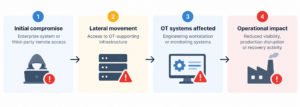
IT/OT convergence can also allow threats to move between connected environments. Attackers who compromise an enterprise application or user account may attempt to access industrial systems. Poor network segmentation and excessive access permissions can increase this risk.
The consequences may extend beyond information security. Depending on the affected systems, an incident could disrupt production, reduce operational visibility, or affect industrial safety.
The ISA/IEC 62443 series of standards provides guidance for managing cybersecurity risks in industrial automation and control systems. Organisations can use these principles to establish security zones, control communications, and define responsibilities between IT and OT teams.
Key takeaway: Successful IT/OT convergence requires more than connecting networks. Organisations must establish clear security boundaries while protecting industrial reliability and safety.
Why More Connectivity Requires a Different Risk Perspective
A central challenge in Industry 4.0 cybersecurity is understanding how technology dependencies influence operational risk. Digitalisation improves visibility and efficiency, but it also creates new connections between industrial assets and external services. These connections can allow cybersecurity incidents to affect systems beyond the initial point of compromise.
As industrial environments become more interconnected, organisations must also consider how failures or compromises in one system could affect other operational components. A cybersecurity incident involving a supporting service may have consequences for industrial operations even when the attacker does not directly compromise a PLC or other control system.
Industrial cybersecurity risk must therefore consider operational consequences, not just technical vulnerabilities.
How Cyber Incidents Can Affect Connected Industrial Systems
Consider a cyberattack against a remote access platform used by an industrial facility. A compromise could expose engineering workstations, monitoring infrastructure, or systems supporting industrial equipment.
Similarly, an incident affecting an identity service or shared infrastructure component could disrupt multiple industrial applications. The impact depends on the systems involved and their operational dependencies.
An asset that appears relatively unimportant from a traditional IT perspective may support a critical industrial function. Conversely, a highly connected platform may have no legitimate requirement to communicate directly with industrial controllers.
These distinctions matter when determining which assets require stronger protection and where organisations should restrict connectivity.
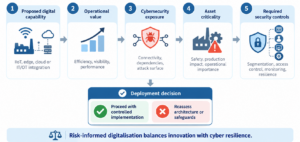
The key question is not simply “Which systems are vulnerable?” but “Which dependencies could allow a cyber incident to disrupt critical industrial operations?”
By incorporating operational context into cybersecurity assessments, organisations can better prioritise risks and allocate security resources.
Strengthening Industry 4.0 Cybersecurity Through Risk-Informed Decisions
Industrial cybersecurity should not be framed as a choice between digital innovation and security. Organisations must determine where connectivity provides operational value and how they can manage the resulting risks.
This approach requires cybersecurity to become part of technology planning, system architecture, procurement, and operational governance.
Understand What Is Connected and Why
Organisations should maintain visibility into industrial assets, including IIoT devices, edge gateways, engineering systems, and external connections. Asset inventories should identify operational functions, system ownership, and communication dependencies.
Understanding why each connection exists helps distinguish necessary integration from unnecessary exposure. It also allows security teams to identify which industrial processes could be affected by a compromised or unavailable component.
Restrict Communication Between Security Zones
Network segmentation should limit communication between industrial systems, enterprise infrastructure, and external services. Where possible, industrial data should pass through controlled interfaces rather than unrestricted connections to production systems.
Security teams should assess communication pathways, supported protocols, and operational requirements. They must also consider the consequences of a potential compromise.
Connectivity should reflect operational necessity rather than technological convenience.
Secure Remote and Third-Party Access
Remote access allows equipment manufacturers and service providers to diagnose issues without visiting industrial facilities. Although this improves maintenance efficiency, it also introduces additional access pathways.
Organisations should restrict vendor access to authorised users, approved systems, and necessary activities. Strong authentication, time-limited access, session monitoring, and regular permission reviews can reduce third-party cybersecurity risks.
Design for Operational Resilience
Organisations must prepare for situations in which external services, network connections, or security controls become unavailable. They should assess whether essential processes can continue safely during disruptions.
This includes maintaining appropriate local capabilities, validating backup and recovery procedures, and coordinating incident response between cybersecurity and engineering teams.
Cyber resilience is not only about preventing incidents. It is also about limiting their operational impact and supporting safe recovery.
AICOT Relevance: Cybersecurity for Increasingly Connected OT Environments
Industry 4.0 introduces new challenges for industrial cybersecurity. As OT environments become more connected, security teams must understand both cyber threats and their operational context.
An unusual network connection or device activity may not always indicate a security incident. Its significance depends on the affected asset, its function, and the conditions under which the activity occurs.
For AICOT, this highlights the relevance of AI-driven approaches to OT security. AI-assisted analysis can help security teams examine information from multiple sources, identify unusual behaviour, and recognise potential threats.
However, effective industrial threat detection requires more than identifying suspicious technical activity. It requires understanding what that activity means within the industrial process.
Consider communication between an engineering workstation and a PLC. This activity may represent authorised maintenance or a potential cybersecurity threat. Security teams need information about device roles, expected behaviour, and operational conditions to distinguish between these situations.
Industry 4.0 also increases the amount of operational and security data available for analysis. Although this creates additional monitoring challenges, it can provide valuable information for detecting threats and understanding system behaviour.
Within this context, AICOT explores how AI-assisted cybersecurity and contextual analysis can support industrial cyber resilience. The focus is on improving security awareness and threat detection while respecting OT safety, reliability, and operational requirements.
As industrial environments evolve, context-aware cybersecurity approaches will become increasingly relevant to security decision-making.
Conclusion
ndustry 4.0 creates new opportunities through connected devices, distributed computing, cloud integration, and closer IT/OT collaboration. These technologies improve efficiency, increase operational visibility, and support more advanced decision-making.
However, they also expand the industrial attack surface and introduce new cybersecurity dependencies.
IIoT deployments increase the number of assets requiring protection. Edge computing distributes security responsibilities, while cloud integration introduces external dependencies. IT/OT convergence creates additional pathways between previously separated environments.
These developments reinforce the need to integrate cybersecurity into industrial digitalisation from the beginning.
Effective Industry 4.0 cybersecurity requires organisations to understand operational dependencies, control communication pathways, and prepare for potential disruptions. Security measures must support innovation while protecting the reliability and safety of industrial processes.
For AICOT, this highlights the importance of context-aware approaches that support threat detection and analysis across connected OT environments.
Ultimately, a smart factory is not defined only by how efficiently its systems communicate. It must also remain secure, reliable, and resilient when facing cyber threats.
About the AICOT Project
Led by Logstail, the project builds on expertise in SIEM, data analytics, and security operations while extending these capabilities to the specific requirements and constraints of OT environments.
Follow the AICOT project at https://aicotproject.eu for project updates and insights into AI-driven OT cybersecurity.
AICOT is funded by the European Union’s Digital Europe Programme under Grant Agreement No. 101249826. Views expressed are those of the authors and do not necessarily represent the European Union or the European Cybersecurity Competence Centre.