June 29, 2026
How OT Security Is Different from IT Security
IT vs OT security involves different priorities because industrial environments protect more than data, users, and business systems. They also protect physical processes, equipment availability, production continuity, human safety, and critical services.
This changes how security teams monitor threats, prioritise incidents, and respond to suspicious activity.
In an IT environment, isolating a workstation, disabling an account, or deploying a patch may be a standard response. In an Operational Technology environment, the same action could interrupt production, affect equipment, or disrupt an essential service.
Organisations therefore need a security platform that can provide visibility across both environments while allowing response workflows to reflect their different operational requirements.
The Logstail Security Suite brings monitoring, asset visibility, alert handling, automated playbooks, and governance workflows into one platform. This gives security teams a common operational layer for detecting, investigating, and responding to threats across connected IT and OT environments.
When Separate Visibility Creates an Operational Blind Spot
A production environment begins reporting intermittent communication failures. The OT team sees equipment alarms, while the IT team sees healthy servers and no obvious network outage.
The root cause could be a remote-access session, an engineering workstation, a network-security control, or a change affecting communication with an industrial asset. As a result, when each team investigates through separate tools, related evidence may remain disconnected.
Logstail helps close this gap by bringing identity, endpoint, remote-access, network, asset, vulnerability, and OT-supporting telemetry into a shared investigation workflow.
IT vs OT Security: Why Availability and Safety Matter
Information Technology environments typically include:
- Endpoints and servers
- User identities
- Cloud platforms
- Business applications
- Enterprise networks
- Organisational data
Operational Technology environments include:
- Industrial Control Systems
- SCADA systems
- Programmable Logic Controllers
- Engineering workstations
- Human-Machine Interfaces
- Industrial network infrastructure
IT security commonly prioritises the confidentiality, integrity, and availability of digital information and business services.
However, these priorities also matter in OT, while industrial environments place additional emphasis on equipment availability, process integrity, safety, and operational continuity.
This affects incident response.
In IT, a SOC analyst may immediately isolate a compromised laptop through an endpoint security workflow. In OT, isolating an engineering workstation or blocking communication with an industrial asset may require validation from operators or engineers.
The technical evidence may indicate that containment is necessary, but the response must also be operationally safe.
Logstail helps teams manage this difference by centralising security evidence while allowing incidents to be investigated, escalated, and handled through structured cases and response playbooks.
The IT/OT Divide Is Also Organisational
The IT vs OT security divide is not limited to systems and protocols.. The teams also work with different priorities, responsibilities, and tolerance for change.
IT teams may regularly update systems, restrict accounts, isolate endpoints, and automate containment. OT teams may operate equipment that has remained in production for decades and cannot be restarted or modified without engineering validation.
Consequently, during an incident, the SOC may want immediate containment, while an OT engineer may first need to assess process dependencies, safety implications, and production impact.
Logstail gives both teams access to the same alerts, evidence, asset information, cases, and response workflows. This supports a shared investigation while keeping operational decisions with the appropriate owners.
How Logstail Supports IT Security Operations
In IT environments, the Logstail Security Suite can provide a central view of activity across endpoints, identities, servers, network infrastructure, cloud services, and security applications.
Security teams can use the platform to collect and correlate events such as:
- Suspicious user authentication
- Privilege escalation
- Malware or unusual process execution
- Changes to critical files or configurations
- Unexpected outbound connections
- Endpoint and server vulnerabilities
- Cloud account activity
- Repeated alerts involving the same user or device
Therefore, instead of investigating each event separately, analysts can use Logstail SIEM to search and correlate related telemetry.
For example, a suspicious login can be examined alongside:
- The identity and device involved
- Recent authentication history
- Process activity on the endpoint
- Network connections made after login
- Related alerts from other security controls
- Known vulnerabilities affecting the system
When the evidence indicates an incident, Logstail SOAR can support consistent response through cases, playbooks, and automated workflows. Logstail positions its Security Suite around SIEM monitoring, agents, asset and patch visibility, SOAR cases and playbooks, and GRC workflows.
Using configured integrations and appropriate approval controls, an IT response workflow could include:
- Enriching suspicious indicators with Logstail CTI
- Creating an investigation case and a Jira ticket for follow-up
- Restricting a compromised account through Microsoft 365
- Blocking a confirmed malicious source through pfSense
- Recording investigation evidence, approvals, and response actions for reporting and compliance
This helps SOC teams move from raw alerts to repeatable investigation and response processes while keeping high-impact actions under analyst control.
Explore the Logstail Security Suite to see how SIEM, SOAR, asset visibility, and governance workflows can work together.
How Logstail Supports OT Security Operations
OT environments require many of the same core security capabilities as IT: visibility, detection, investigation, prioritisation, and response.
The difference is that the evidence must be interpreted within the context of industrial operations.
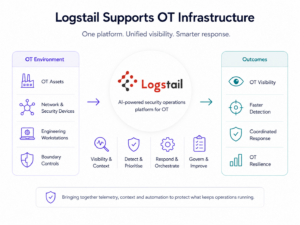
Logstail can provide a central security view of relevant logs, events and network data from connected OT environments, including sources such as:
- Firewalls and network-security devices
- Remote-access and VPN services
- Jump servers
- Engineering workstations
- Windows and Linux systems
- Identity infrastructure
- Network-monitoring tools
- Vulnerability-management systems
- Security controls positioned between IT and OT segments
OT Monitoring Requires Operational Context
OT monitoring requires different technical and operational context. IT environments commonly generate telemetry from identities, endpoints, servers, cloud services, applications, APIs, SNMP, WMI, HTTP, and network-security systems.
OT environments may also include PLCs, HMIs, historians, engineering workstations, SCADA platforms, and industrial communications such as OPC UA, MQTT, and Modbus.
The objective is not simply to collect more data. Security teams need to connect technical activity with:
- The affected asset
- Its role in the industrial process
- Its importance to industrial operations
- The user or system involved
- Related vulnerabilities
- The potential impact on availability and safety
Logstail brings available security evidence, asset information, vulnerabilities, cases, and response workflows together so that incidents can be assessed according to both technical severity and operational impact.
However, this does not mean that every industrial controller should run an endpoint agent or that every response should be automated.
In many OT environments, visibility depends on passive monitoring, network telemetry, security gateways, supporting systems, and integrations that do not interfere with industrial processes.
Logstail can help analysts bring this available evidence into one investigation workflow.
For example, the platform can help correlate:
- Remote access outside an approved maintenance window
- Authentication using a privileged account
- Access to an engineering workstation
- Communication with a sensitive OT network segment
- Related alerts or configuration changes
- Activity involving the same user, device, or source address
Individually, each event may have a legitimate explanation. Together, they may indicate unauthorised access or movement towards the OT environment.
By reviewing the events as a connected sequence, SOC and OT teams can better determine:
- What happened
- Which systems are involved
- Whether the activity was authorised
- What operational processes may be affected
- Who should approve the response
- Which containment action is safe
One Incident Across IT and OT
Consider a vendor account connecting through a remote-access service outside an approved maintenance window.
The same account then authenticates on a jump server, accesses an engineering workstation, and begins communicating with a sensitive OT network segment.
Several systems may hold different parts of the evidence:
- The identity platform records the authentication
- The VPN records the remote session
- Endpoint monitoring records activity on the jump server
- The firewall records communication towards the OT environment
- OT-supporting monitoring identifies unusual activity involving an industrial asset
Although each event may appear routine when viewed separately, together they may indicate unauthorised movement from IT towards OT. Viewed together, they may indicate unauthorised movement from IT towards OT.
How Logstail supports the investigation
- Collect and normalise: Logstail SIEM brings identity, remote-access, endpoint, network, asset, vulnerability, and OT-supporting evidence into one platform.
- Detect: Detection rules identify access outside the approved window, privileged authentication, unusual communication, or activity involving a critical system.
- Correlate: Logstail connects the account, source device, VPN session, jump server, engineering workstation, destination segment, and related alerts within one incident timeline.
- Investigate: Analysts review the evidence through dashboards, searches, alerts, and a structured case. Asset and vulnerability information adds context about the systems involved.
- Prioritise: Analysts assess the incident according to both technical severity and potential operational impact. Access to a standard office endpoint does not carry the same implications as access to an engineering system supporting production.
- Respond: Logstail SOAR creates the case, enriches the evidence, notifies the SOC and OT teams, and guides the response through an approved playbook.
In IT, the playbook may support immediate account restriction or endpoint isolation.
In OT, the workflow may first verify the asset’s operational role, check the maintenance schedule, notify the responsible engineer, and require approval before blocking communication.
The value is not simply that IT and OT data appear in one dashboard. The value is that evidence, asset context, operational impact, ownership, and response decisions remain connected throughout the incident lifecycle.
Where Unified IT/OT Visibility Matters Most
Manufacturing Manufacturing environments combine legacy PLCs, engineering workstations, industrial networks, IoT devices, cloud services, and remote vendor access.
A compromised account, unstable connection, or unauthorised engineering change may affect both enterprise systems and production.
Logstail helps correlate identity, remote-access, endpoint, network, asset, vulnerability, and OT-related evidence so SOC analysts and plant engineers can investigate the same incident through a shared case.
Healthcare. Healthcare environments depend on medical equipment, imaging systems, identity services, clinical applications, servers, and network infrastructure working together.
When a critical system becomes unavailable, teams need to determine quickly whether the cause is the device, the network, an authentication issue, or malicious activity.
Logstail brings the available infrastructure and security evidence into one investigation workflow, helping teams reduce separate investigations and identify the affected service faster.
Energy and Critical Infrastructure Energy environments combine SCADA platforms, field systems, remote-access infrastructure, enterprise networks, smart devices, and external services.
A stolen credential or exposed remote-access service may become a path towards systems supporting generation or distribution.
Logstail connects external exposure, identity activity, VPN access, network controls, asset information, and available OT telemetry within one investigation and response process.
This directly addresses the reviewer’s request to explain which industries are affected.
Managing Legacy Systems and External Exposure
Legacy assets are a common challenge in OT environments.
Industrial equipment may remain operational for many years, depend on vendor-specific software, or require carefully planned maintenance windows. Some systems cannot run modern endpoint tools, while teams cannot patch others without testing and operational approval. Logstail’s value in this context is not limited to patch deployment.
Consider an engineering workstation running vendor software that cannot be patched until the next planned shutdown.
Logstail can keep the risk visible and actively managed by linking the vulnerability with the monitored asset, creating a remediation case, assigning ownership, documenting compensating controls, and monitoring related security activity.
As a result, delayed patching remains a managed and documented risk rather than an unresolved finding.
The platform can help teams:
- Maintain visibility into monitored assets
- Track vulnerabilities and remediation activity
- Correlate risks with related security events
- Create cases for systems that cannot be patched immediately
- Document compensating controls
- Coordinate remediation with system owners
- Maintain evidence for risk and compliance workflows
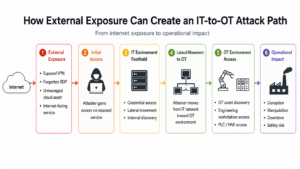
How External Exposure Can Create an IT-to-OT Attack Path
Logstail External Attack Surface Management complements security monitoring by identifying unknown domains, cloud assets, certificates, shadow IT, and risky internet-facing services. This external visibility is especially relevant when exposed remote-access infrastructure, unmanaged services, or forgotten assets could provide an initial path towards connected IT and OT environments.
For example, an exposed VPN, forgotten remote-management service, or unmanaged cloud asset may provide the initial entry point. EASM identifies the external exposure, while Logstail SIEM, asset visibility, SOAR, and GRC support the internal investigation, remediation workflow, ownership, and risk documentation.
Possible compensating controls for an OT asset that cannot be patched immediately may include:
- Network segmentation
- Restricted remote access
- Increased monitoring
- Firewall-rule changes
- Vendor-access controls
- Application allowlisting
- Documented maintenance and remediation plans
The key is to connect the vulnerability with asset ownership, exposure, operational importance, and an actionable response process.
How Logstail Extends Its OT Capabilities Through AICOT
AICOT is an EU-funded project coordinated by Logstail that is building on Logstail’s existing SIEM and data-analytics capabilities.
The project aims to add capabilities designed specifically for OT environments, including advanced machine learning, anomaly detection, OT protocol analysis, threat intelligence, and real-time monitoring, detection, and response.
Through the project, Logstail is working towards a more OT-native security platform that can help defenders understand:
- Which industrial assets are involved
- How those assets communicate
- Whether observed behaviour is expected
- How multiple signals may form an attack sequence
- What operational impact may result
- Which response options are appropriate
This distinction is important.
The existing Logstail product provides the foundation for centralised monitoring, SIEM correlation, asset visibility, SOAR workflows, and governance.
AICOT extends that foundation with deeper OT-specific monitoring, protocol understanding, AI-assisted analysis, and context-aware response support.
Building the Skills to Use the Platform Effectively
Technology alone does not create resilience.
Analysts need the skills to search logs, triage alerts, correlate events, manage cases, and respond through structured workflows.
The Logstail Cybersecurity Academy supports this by providing role-based training, hands-on labs, learning paths, and practical platform exercises. Logstail’s platform training includes features such as Discover, Dashboards, Alerts, SOAR, and Case Management, along with alert-triage and incident-response scenarios.
Build practical investigation and response skills through the OT-ICS Advanced Cybersecurity Essential learning path.
Start with One Critical Dependency
Unified IT/OT visibility does not require an organisation to transform the whole environment at once.
A practical starting point may be:
- One production line
- One remote-access pathway
- One engineering workstation segment
- One IT/OT firewall boundary
- One critical operational service
Teams can begin by mapping the dependency, connecting the relevant telemetry to Logstail, creating shared dashboards and alerts, and defining the escalation and approval workflow.
They can then measure improvements in investigation time, alert quality, ownership clarity, and response coordination before expanding to additional systems.
Practical Takeaway
IT vs OT security requires different operational decisions, but both environments depend on connected evidence, shared visibility, and coordinated teams.
Logstail brings together monitoring, SIEM correlation, asset and vulnerability context, case management, SOAR playbooks, EASM, and governance workflows across the incident lifecycle.
This helps organisations identify activity that begins in IT, understand how it may affect OT, prioritise incidents according to operational impact, and coordinate response without applying unsafe IT actions to industrial systems.
Through AICOT, solely coordinated and developed by Logstail, this foundation is strengthened with AI-driven OT monitoring, risk prioritisation, and context-aware response capabilities for critical infrastructure environments.
Follow the project on LinkedIn and X for project updates and practical insights into AI-driven OT cybersecurity.
The AICOT project has received funding from the European Union’s Digital Europe Programme under Grant Agreement No. 101249826. Views and opinions expressed are those of the authors and do not necessarily reflect those of the European Union or the European Cybersecurity Competence Centre.