September 7, 2026
When OT Clocks Drift: Why Time Synchronization Matters for Cybersecurity
Introduction
In industrial environments, OT time synchronization works quietly in the background. It helps operators understand when an alarm occurred, allows historians to record process activity, and gives engineers a way to trace events across different systems. Most of the time, nobody needs to think much about it.
That changes when something goes wrong.
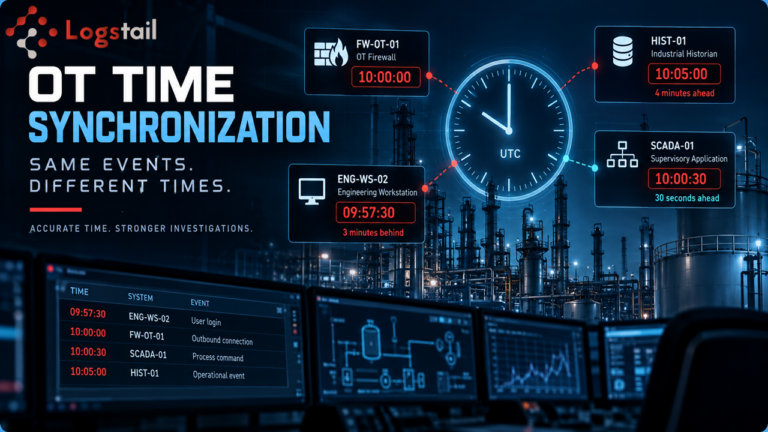
Imagine a security team investigating unusual activity on an engineering workstation. The firewall shows a connection at 10:00, the workstation records the session at 09:57, and the historian reports an operational event at 10:05. All three systems appear to be describing the same period, but their timestamps do not line up.
At first, this may look like a complicated incident. In reality, part of the problem could be much simpler: the systems may not agree on what time it is.
This is where time synchronization becomes an important part of OT cybersecurity. Accurate clocks help security teams correlate events, reconstruct activity, and understand whether one action happened before or after another. When clocks drift, the logs may still be available, but the timeline they describe can become difficult to trust.
The challenge is therefore not only collecting more security data. It is ensuring that the evidence tells a reliable story when an investigation matters most.
Why OT Time Synchronization Matters
Industrial environments generate security and operational evidence across many different systems. Firewalls, engineering workstations, historians, SCADA applications, network devices, and monitoring platforms may all record different parts of the same activity.
These systems do not necessarily maintain time in the same way. Some may use a central NTP server, others may synchronize through an operating-system domain, and certain industrial devices may use Precision Time Protocol (PTP) or vendor-specific mechanisms. Legacy systems may also have limited synchronization capabilities.
NIST SP 800-82 Rev. 3, Guide to Operational Technology (OT) Security, identifies time synchronization as important for event and log correlation, authentication, access control, and other OT functions. It also recommends common time sources, backup sources, and monitoring the time infrastructure.
This matters because a timestamp is not simply a label attached to an event. It is part of the evidence used to determine what happened, when it happened, and which activity may have preceded another.
If the clocks are inconsistent, the SOC may still have all the relevant logs but struggle to establish a reliable sequence. However, clock drift does not automatically indicate malicious activity. Configuration errors, unavailable time sources, network problems, and maintenance can also produce inaccurate timestamps.
The security problem is that the evidence may become less reliable precisely when an investigation depends on it.
Why Clock Drift Changes OT Risk
Time synchronization can appear to be a small technical detail, but it becomes important when several systems must be investigated together.
For example:
FW-OT-01 — OT firewall
ENG-WS-02 — Engineering workstation
HIST-01 — Industrial historian
SCADA-01 — Supervisory application
All four systems may record activity related to the same operational event. However, if their clocks differ, the timestamps may not reflect the actual order in which the activity occurred.
Consider the following illustrative example. All times use the same time zone.
| System | Reference time | Recorded timestamp | Clock offset |
|---|---|---|---|
| FW-OT-01 | 10:00:00 | 10:00:00 | 0 seconds |
| ENG-WS-02 | 10:00:30 | 09:57:30 | 3 minutes behind |
| HIST-01 | 10:01:00 | 10:05:00 | 4 minutes ahead |
The engineering workstation is three minutes behind the reference clock, while the historian is four minutes ahead. Without accounting for those differences, the workstation event appears to occur before the firewall connection, even though it actually happened thirty seconds later.
Traditional log analysis tends to ask, “What happened at this timestamp?” A time-aware OT investigation must go further and ask, “How reliable is the clock that produced this timestamp?”
From Clock Drift to Investigation Risk
1. Map the Time Dependencies Behind OT
The first step is understanding how operational systems obtain and maintain time.
Relevant systems can include NTP servers, domain controllers, hypervisors, engineering workstations, historians, SCADA servers, network devices, OT monitoring infrastructure, and industrial devices that require synchronized time.
The inventory should document more than the hostname and operating system.
| Context | Example |
|---|---|
| Asset | HIST-01 |
| Function | Industrial historian |
| Configured time source | OT-NTP-01 |
| Time zone | UTC |
| Synchronization status | Active |
| Last successful sync | Recorded |
| Observed offset | +4 minutes |
| Operational criticality | High |
| Responsible team | OT Engineering |
This context changes the investigation because a timestamp from a synchronized server is not equivalent to a timestamp from a system whose clock has been drifting for several hours.
The objective is to understand which systems provide reliable time, which systems depend on the same source, and which records may require additional validation before they are used in an incident timeline.
2. Monitor the Time Synchronization Infrastructure
The time source itself is part of the security and operational infrastructure.
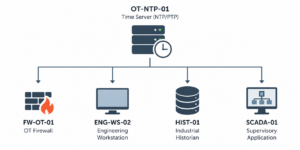
A central time service may support multiple systems simultaneously. If it becomes unavailable, is misconfigured, or provides incorrect time, several devices may begin to produce inconsistent records.
High-value telemetry can include synchronization failures, large changes in clock offset, unexpected time-source configuration changes, time-service restarts, manual system-time modifications, and loss of synchronization across several systems.
A single synchronization failure may represent a temporary infrastructure issue. However, repeated failures across several operational systems, or a sudden time change on a critical server, should be investigated in context.
The useful detection is not simply:
A time synchronization service failed.
It is:
Several OT systems lost synchronization with their configured time source, creating uncertainty in the timestamps used for security investigation.
What Could This Look Like in Practice?
The following sequence is illustrative, not a record of a real incident.
An engineering workstation is known to be three minutes behind the reference clock. A historian is four minutes ahead. During an investigation, the SOC receives the following records:
10:00:00 — Firewall records a connection to ENG-WS-02
09:57:30 — Engineering workstation records the corresponding session
10:05:00 — Historian records an operational event
At first glance, the workstation activity appears to occur before the firewall connection. The historian event appears several minutes later.
The analyst checks the synchronization status and confirms the known offsets. If those offsets were stable during the relevant period, the reconstructed sequence becomes:
10:00:00 — Firewall connection
10:00:30 — Engineering workstation session
10:01:00 — Historian event
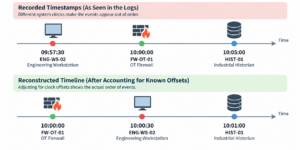
The original records have not changed. What changed is the analyst’s understanding of their timestamps.
However, if the offsets were measured only after the incident, the SOC should not automatically assume they were identical throughout the earlier period. A clock may have drifted, been corrected, or changed time sources in between.
The important question becomes: are we investigating the activity, or are we investigating an incorrect timeline created by the clocks?
3. Preserve Timestamp Context During Collection
Centralizing logs does not automatically correct inaccurate source timestamps.
A SIEM may receive an event at one time while the original system reports that the event occurred at another. Both values can be useful, but they represent different things.
Event time is when the source system says the activity occurred. Ingestion time is when the monitoring platform received the event. Observed offset is the measured difference between the source clock and a trusted reference, where that information is available.
For example, a log received at 10:06 with a source timestamp of 09:57 does not automatically prove that the source clock is nine minutes behind. The event may have been queued, delayed by the network, or forwarded after connectivity was restored.
Time-zone differences can also create apparent inconsistencies without the underlying clocks being wrong. Converting timestamps to a common time zone is therefore important, but it is not the same as correcting clock drift.
The SOC should preserve the original timestamp and document any normalization or correction used during the investigation.
The objective is not simply to make every timestamp look consistent, but to retain enough information to explain how the final investigation timeline was constructed.
4. Reconstruct the Timeline Without Hiding Uncertainty
Once the relevant systems and time sources have been identified, the SOC can begin reconstructing the incident by determining whether the clocks were synchronized during the relevant period, whether their offsets are known, and whether independent evidence supports the event order.
A useful investigation record should distinguish between confirmed order, which is supported by reliable timestamps or other independent evidence; estimated order, which has been reconstructed using known offsets; and uncertain order, where the available evidence does not establish a reliable sequence.
This distinction matters because a corrected timeline should not appear more precise than the evidence allows.
A historian event may still be useful even when its timestamp is uncertain, but the investigation should document that limitation rather than silently treating the event time as exact. This is the value of connecting security events with time-source and asset context.
5. Prioritise According to Operational Importance
Not every clock problem creates the same level of risk.
A time synchronization issue affecting a development workstation is one problem, while the same issue affecting a historian, authentication service, or critical OT monitoring server may have a greater operational consequence.
Prioritisation should consider asset criticality, the number of dependent systems, the size and duration of the clock offset, and the importance of the affected records.
The objective is not to introduce another scoring model, but to ensure that time integrity is prioritised according to the systems and investigations that depend on it.
High-Value Detection Scenarios
Sudden Clock Offset on a Critical Server
A small clock adjustment may be normal. A sudden change of several minutes on a historian or engineering workstation is different, particularly if it occurs during suspicious activity.
Correlate the time change with administrative activity, synchronization status, recent configuration changes, and the affected asset’s operational role.
The event does not prove malicious activity, but it may affect the reliability of evidence collected during the same period.
Multiple OT Systems Lose Synchronization
Several systems losing synchronization within the same period may indicate a shared time-source or network problem.
The investigation should identify whether those systems depend on the same NTP server, domain controller, or other synchronization infrastructure.
Instead of investigating each device independently, the SOC should determine whether the failures have a common cause.
Unexpected Time-Source Configuration Change
A time-source change may be legitimate maintenance. However, an unexpected modification to a critical server’s synchronization configuration should be reviewed, especially when performed by an unusual identity.
Correlate the change with approved maintenance activity and subsequent clock-offset changes.
Event Time and Ingestion Time Diverge
A large difference between the source timestamp and the time an event reaches the SIEM may indicate delayed delivery, backlog, or clock inconsistency.
The SOC should determine which explanation is supported by the available evidence rather than assuming that the source clock is incorrect.
Conflicting Timestamps During an Incident
If firewall, workstation, and historian records appear to describe the same activity in an impossible order, the investigation should validate time zones, clock offsets, and synchronization history before drawing conclusions.
The critical question is:
Do the events contradict each other, or do the clocks?
Logstail Security Suite: Connecting the Evidence
OT time-integrity investigations can involve evidence from time servers, operating systems, network devices, historians, and security infrastructure. Investigating those systems independently can make it difficult to determine whether a timestamp inconsistency is isolated or affects several operational assets.
The Logstail Security Suite provides a shared security-operations layer for SIEM monitoring, asset visibility, alerts, cases, and response workflows.
With compatible data sources connected, security teams can collect relevant synchronization events alongside infrastructure and security activity. Detection rules can be configured around the available telemetry, while cases can bring together affected assets, related alerts, investigation notes, and response tasks.
For example, a configured investigation could connect a time-service failure with the affected historian, its configured time source, and other systems that lost synchronization during the same period.
The objective is not to claim that SIEM automatically makes inaccurate clocks correct. It is to help analysts identify the inconsistency, preserve the evidence, and understand how the time problem affects the investigation.
Response workflows can then assign investigation tasks, notify responsible teams, document known offsets, and coordinate corrective action. Changes that could affect production should remain subject to appropriate operational approval.
Example Response Flow
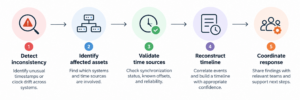
Correcting a clock on a production system should be planned with the responsible operational team, particularly where time changes could affect applications, authentication, scheduled tasks, or process records.
AICOT: Extending Visibility Deeper into OT
Time integrity is one part of the broader industrial security problem. As OT monitoring becomes more dependent on data from different systems, understanding the quality and context of that data becomes increasingly important.
Logstail is leading AICOT — AI-Driven Cyber Defense Platform for Operational Technology Environments in Critical Infrastructure. AICOT builds on Logstail’s existing SIEM and data-analytics capabilities and is intended to extend them with machine learning, anomaly detection, OT protocol analysis, behavioural monitoring, and AI-assisted threat detection.
In this model, Logstail provides the security-operations foundation for collecting and investigating evidence, while AICOT extends that direction toward deeper understanding of industrial communication and behaviour.
The connection to time synchronization is therefore a design consideration: OT-native analysis depends on reliable, well-contextualised telemetry.
Conclusion
An OT security incident can become difficult to reconstruct even when the relevant logs are available. If the systems recording those logs disagree about time, the SOC may struggle to establish the correct sequence of activity.
This is why OT cybersecurity must account for the infrastructure behind the timestamps, not only the devices generating the events. The Logstail Security Suite can support the collection, correlation, and investigation of relevant evidence, while AICOT extends the broader direction toward OT-native monitoring and analysis.
Understanding time sources, preserving timestamp context, and validating clock offsets gives defenders a better foundation for reliable incident reconstruction.
The objective is not simply to collect more logs. It is to ensure that the evidence can be trusted when the investigation matters most.
Follow the project on LinkedIn and X for project updates and practical insights into AI-driven OT cybersecurity.
The AICOT project has received funding from the European Union’s Digital Europe Programme under Grant Agreement No. 101249826. Views and opinions expressed are those of the authors and do not necessarily reflect those of the European Union or the European Cybersecurity Competence Centre.
Contact Our Experts or Sign Up for Free