August 31, 2026
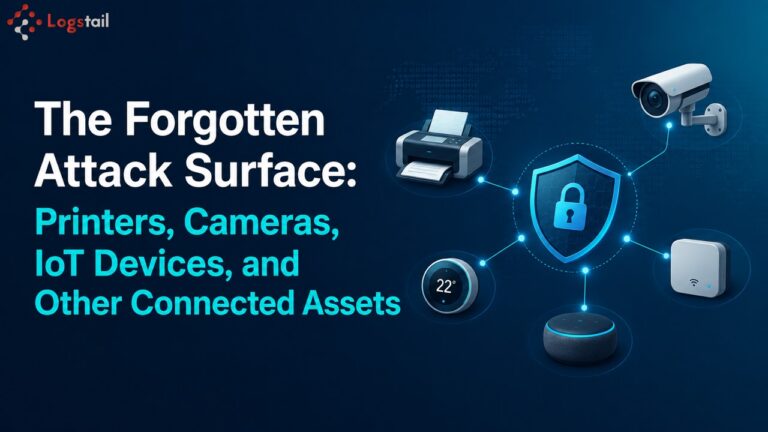
The Forgotten Attack Surface: Printers, Cameras, IoT Devices, and Other Connected Assets
Introduction
When organizations think about their attack surface, the first things that usually come to mind are laptops, servers, cloud workloads, applications, and databases. But modern environments are far more connected than that.
A network may also contain multifunction printers, surveillance cameras, access-control systems, smart conference-room equipment, environmental sensors, industrial devices, building-management systems, network appliances, storage devices, and hundreds of other connected assets.
Many of these devices were never designed with the same security expectations as modern endpoints. Some have limited logging capabilities. Others are difficult to patch, managed by different teams, or forgotten entirely after deployment. That makes them an attractive blind spot for attackers.
The problem is not simply that these devices can be vulnerable. The bigger problem is that organizations may not know what they have, where it is exposed, who owns it, or what it is doing. This is where a modern security strategy needs to move beyond traditional endpoint protection and consider the entire connected environment.
Your Attack Surface Is Bigger Than Your Asset Inventory
Traditional asset inventories tend to focus on assets that security and IT teams deliberately manage. That approach makes sense—but it can leave gaps. A printer installed several years ago may still be connected to the corporate network. A security camera may expose a management interface. An IoT sensor may communicate with a cloud service that was never documented. A forgotten appliance may still have an internet-facing service enabled. The organization may consider these devices peripheral. An attacker does not.
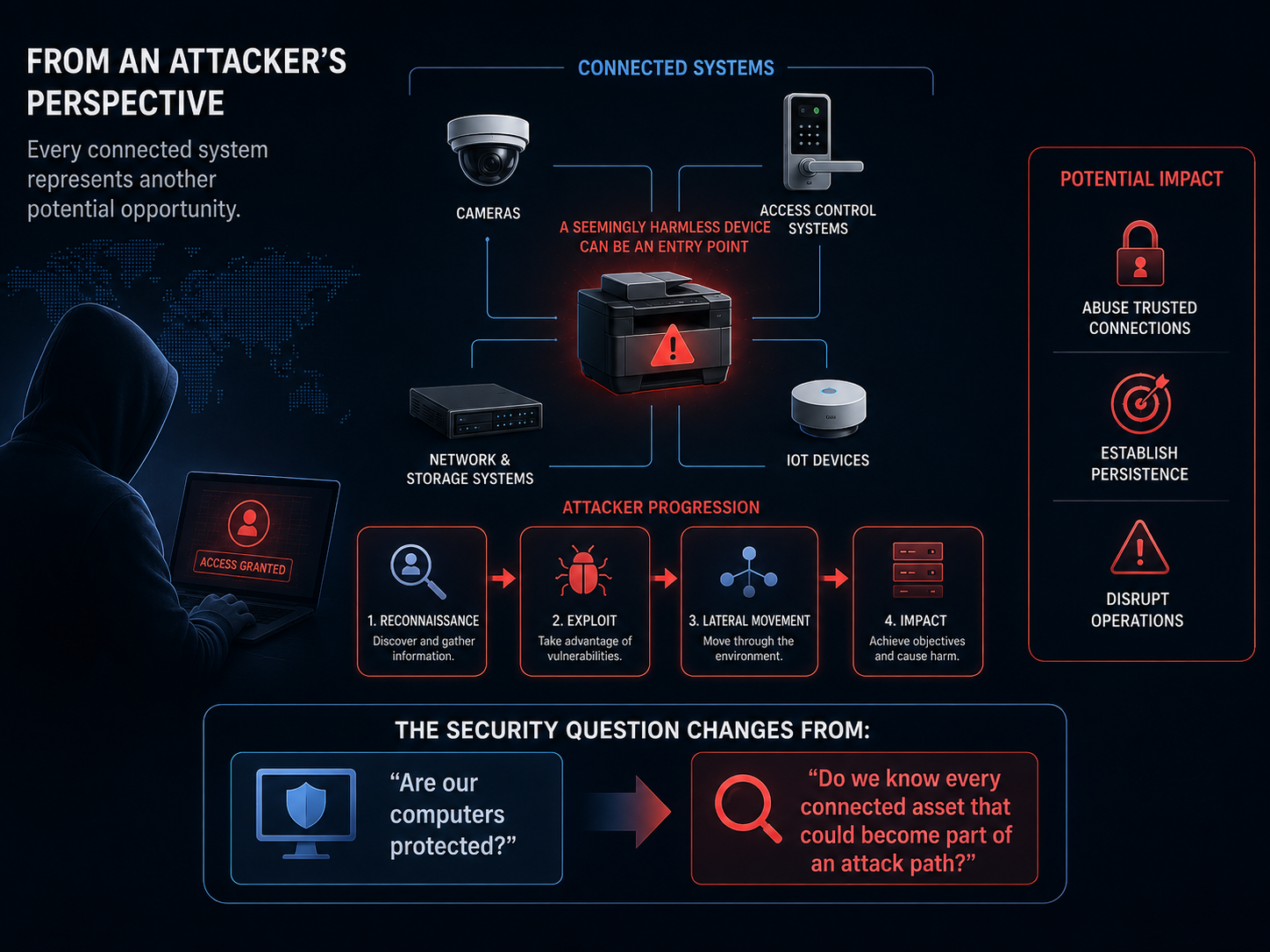
From an attacker’s perspective, every connected system represents another potential opportunity. A seemingly harmless printer, camera, or IoT device can reveal valuable information about an organization, expose credentials or sensitive configuration data, or contain outdated software and firmware that can be exploited. Once compromised, such a device could provide an initial foothold into the environment, enable lateral movement toward more valuable systems, allow attackers to abuse trusted network connections, establish persistence, or even disrupt critical physical and business operations. The security question therefore changes from “Are our computers protected?” to “Do we know every connected asset that could become part of an attack path?” That is a much harder question to answer.
Why Connected Devices Are So Difficult to Secure
Printers, cameras, IoT devices, and other connected systems are increasingly integrated into modern business environments. They may operate across different networks, locations, and departments, and are often managed separately from traditional IT infrastructure. As a result, maintaining consistent visibility, configuration, patching, and monitoring across these devices can be difficult. Printers, cameras, IoT devices, and other connected systems introduce several challenges that traditional security programs can struggle to address.
1. They are easy to forget
Organizations constantly add devices. A new printer arrives. Cameras are installed during an office renovation. A facilities team deploys sensors. A business unit purchases a smart device without involving security. Over time, these assets can disappear from the organization’s security inventory while remaining connected to the network. This creates asset visibility drift: the environment changes faster than the inventory.
2. They may have long lifecycles
Enterprise endpoints are frequently replaced and updated. Connected devices can have much longer lifecycles. A camera, printer, building-management controller, or industrial device may remain operational for years. Its firmware may not receive updates as frequently as conventional operating systems, and replacing it may require significant operational effort. That can leave organizations managing technology that is difficult to patch or modernize.
3. Security is often not the primary design objective
Many connected devices are designed first to perform a specific physical or business function. A printer needs to print. A camera needs to record video. A sensor needs to collect measurements. An access-control system needs to control doors. Security is important—but historically it has not always been the central design requirement. This can result in weak default configurations, unnecessary services, limited authentication controls, insufficient logging, or management interfaces that were never intended to be exposed to the public internet.
4. Ownership can be unclear
Who owns a network-connected camera? Security? Facilities? IT? Physical security? A third-party provider? The answer may depend on the organization. When ownership is unclear, vulnerabilities can remain unresolved because nobody is clearly responsible for remediation.
The Internet-Facing Problem
The risk becomes particularly serious when these systems are exposed to the internet. An organization may have a carefully secured primary website and well-managed cloud infrastructure while simultaneously exposing an overlooked service somewhere else. Attackers continuously perform reconnaissance to identify internet-facing systems, services, technologies, certificates, domains, and other signals that can reveal potential weaknesses. This is why understanding the external attack surface matters. You cannot protect what you cannot see.
External Attack Surface Management, or EASM, approaches the problem from an attacker’s perspective. Instead of starting with the organization’s internal asset inventory, EASM asks: “What can the outside world see?” That distinction is critical.
EASM: Finding What the Organization Forgot
Logstail’s External Attack Surface Management capability is designed to discover and monitor internet-facing assets, identify exposure, and help security teams prioritize the risks that matter. Its EASM workflow can identify domains, subdomains, public IP addresses, URLs, web applications, exposed services, ports, technologies, certificates, and other external exposure signals. This creates an external perspective of the organization. Consider a hypothetical example:
A company believes its public infrastructure consists of:
- Its corporate website
- Several cloud applications
- A VPN gateway
- Public APIs
An EASM assessment might reveal additional infrastructure that the security team did not realize was externally visible:
- An old subdomain
- A forgotten cloud endpoint
- An exposed management service
- A certificate associated with an unknown hostname
- A test environment
- A third-party system connected to the organization’s digital footprint
The significance is not that every discovered asset is automatically vulnerable. The significance is that the organization now knows the asset exists and can determine whether it should be exposed. That is the first step toward reducing risk.
However, knowing what is exposed is only part of understanding the organization’s security posture. An externally visible system may be legitimate, misconfigured, vulnerable, or actively targeted. EASM provides the external perspective needed to understand what attackers can discover, while SIEM provides visibility into security events and activity occurring across the environment.
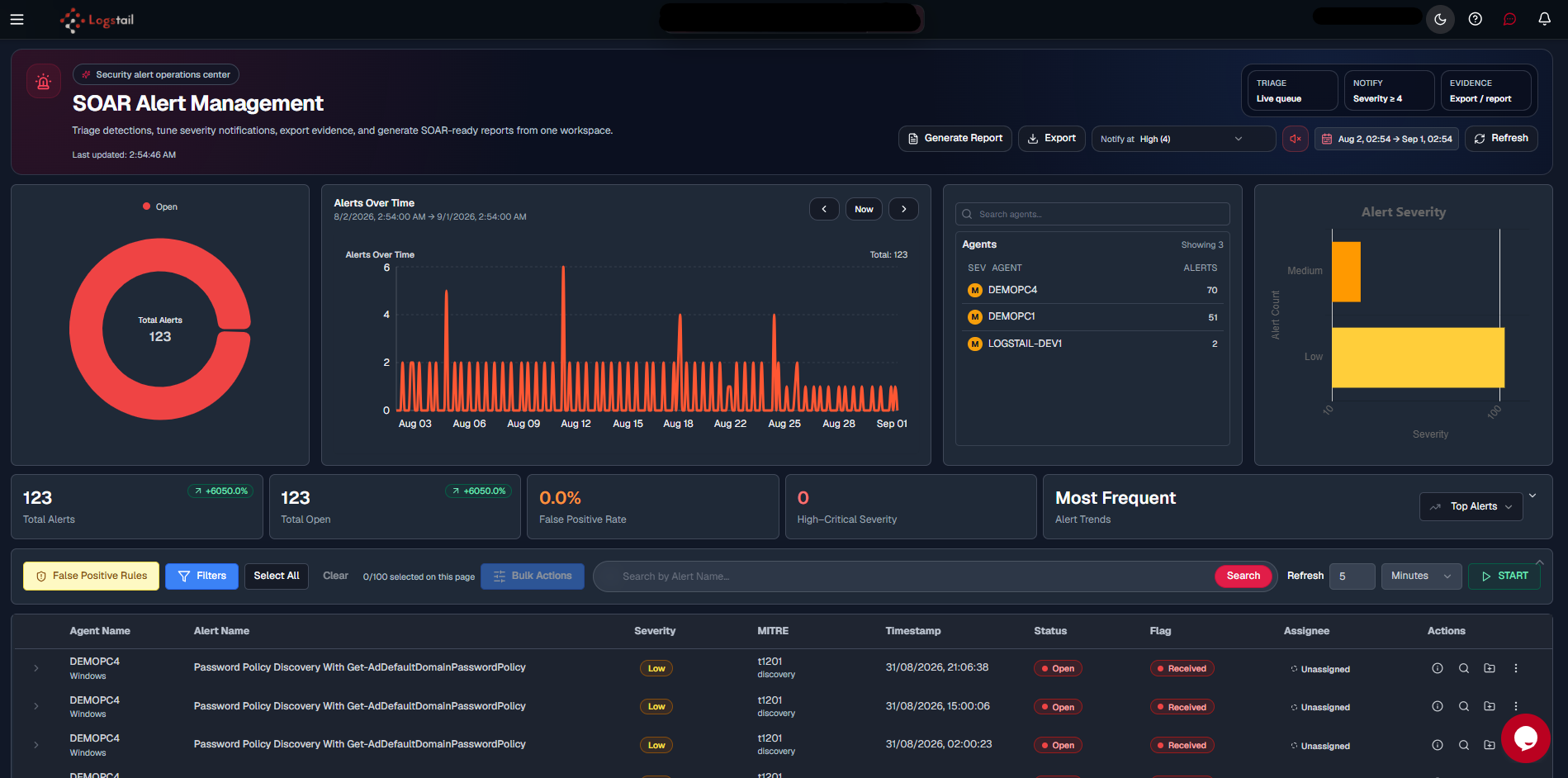
Logstail’s SIEM/SOAR platform supports centralized collection of logs, events, metrics, packets, and other telemetry, alongside search, investigation, alert management, case management, and response workflows. When these capabilities are considered together, security teams can connect two important questions: What can attackers see, and what are they doing?
This connection helps move security monitoring beyond asset discovery toward understanding whether exposed systems are generating suspicious activity, attracting attempted exploitation, or requiring investigation and response.
The Value of Connecting External and Internal Visibility
Imagine an organization discovers an internet-facing device or service that was not expected to be public. EASM identifies the exposure, but that discovery should immediately trigger a second question: Has anyone been interacting with it? Security teams can then investigate relevant telemetry through their SIEM environment to determine whether the exposed asset is simply present on the internet or is attracting suspicious activity. They may look for:
- Authentication attempts
- Unusual network activity
- Repeated connection attempts
- Suspicious source addresses
- Unexpected administrative activity
- Abnormal behavior involving related systems
- Indicators of lateral movement
The two perspectives reinforce each other. EASM tells you, “This asset is exposed.” SIEM tells you, “This activity is occurring.” SOAR can help you determine, “Here is what we can do about it.” Together, these capabilities create a more complete security lifecycle:
Discover → Assess → Monitor → Detect → Investigate → Respond → Remediate
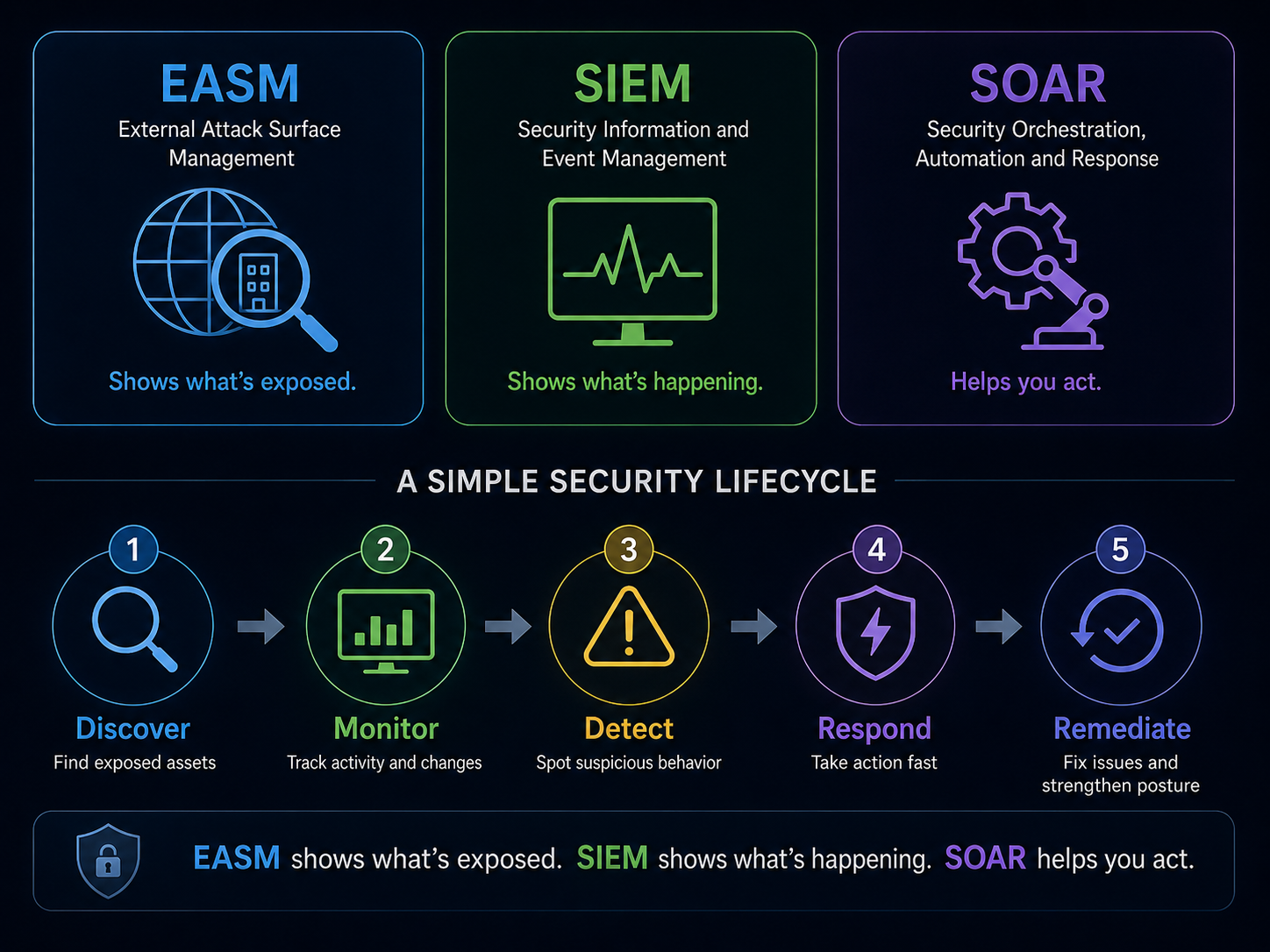
Rather than treating attack-surface management and security operations as separate disciplines, organizations can use them as connected parts of the same defense strategy. External visibility helps identify what could be targeted, while internal security telemetry helps determine whether that exposure is being probed, exploited, or otherwise involved in suspicious activity. Response and remediation capabilities then help security teams act on those findings.
A Printer Can Become More Than a Printer
Consider a simple example: An organization deploys a network printer across several offices. The printer contains an embedded web interface for administration. It communicates with internal systems and stores information temporarily. Over time, its firmware becomes outdated. From an operational perspective, it is simply a printer. From a security perspective, however, it is a connected system with:
- Software
- Network connectivity
- Authentication
- Data
- Administrative interfaces
- Potential vulnerabilities
- Relationships with other systems
If that device becomes externally accessible or is compromised internally, it could potentially become part of a broader attack chain. The same principle applies to cameras, smart displays, sensors, building-management systems, and other connected technologies. The device itself may not be the attacker’s ultimate target. It may simply be the easiest door into something that is.
IoT Security Requires More Than Vulnerability Scanning
It is tempting to frame the problem entirely around vulnerabilities. But vulnerability management alone does not solve the visibility problem. An organization first needs to understand:
- What assets exist?
- Which assets are connected?
- Which assets are internet-facing?
- Which assets are unexpected?
- Which assets are business-critical?
- Which assets are generating suspicious activity?
- Who owns each asset?
- What should happen when something changes?
This is why continuous visibility matters. A point-in-time assessment can tell you what existed when the assessment occurred, but a continuously monitored environment helps security teams identify how that attack surface changes over time. New domains appear, certificates are issued, cloud resources are created, services become exposed, systems are decommissioned, and shadow IT emerges. As these changes occur, the organization’s attack surface evolves with them.
Logstail’s EASM approach emphasizes continuous external exposure visibility and monitoring, helping organizations identify newly discovered assets, certificate events, exposed services, and other risk signals as they emerge. This transforms attack-surface management from a periodic exercise into an ongoing security process, allowing security teams to maintain a more accurate and up-to-date understanding of their external exposure.
Building a Connected-Asset Security Strategy
Organizations do not necessarily need to replace every connected device. Instead, they need to understand which devices are exposed, what risks they introduce, and whether appropriate controls are in place to manage those risks. A practical approach is to improve visibility, assess the security of connected devices, prioritize the most significant exposures, and establish processes for ongoing monitoring and remediation. A practical strategy can start with five steps.
1. Discover
Build visibility across both known and unknown assets. Start with internal inventories, network data, cloud environments, and external discovery. The goal is to establish a realistic picture of the organization’s connected environment.
2. Identify external exposure
Determine which assets are visible from the internet.
Pay particular attention to:
- Unexpected public IP addresses
- Exposed management interfaces
- Unnecessary services
- Forgotten subdomains
- Old infrastructure
- Third-party connections
- Remote-access systems
- Cloud resources
EASM can provide an attacker-view perspective that complements traditional internal inventories.
3. Prioritize
Not every device represents the same level of risk. A public-facing management interface on a business-critical system should receive more attention than an isolated device with no external exposure. Prioritization should consider exposure, business criticality, exploitability, ownership, and potential impact.
4. Monitor
Once an asset is identified, monitor for meaningful changes and suspicious activity. External monitoring can identify changes to the attack surface. SIEM monitoring can provide visibility into relevant internal events and activity. Together, they create a stronger feedback loop.
5. Respond
When suspicious activity is detected, security teams need a process for investigation and response. This is where SIEM and SOAR capabilities become particularly valuable. Logstail’s platform supports alert investigation, case management, and automated response workflows, helping teams move from detection toward coordinated action.
The Bigger Picture: One Attack Surface, Not Separate Networks
The distinction between “IT,” “IoT,” “OT,” “physical security,” and “cloud” can be useful operationally. Attackers do not necessarily respect the boundaries between IT, IoT, OT, physical security, and cloud environments. A forgotten internet-facing service can become an entry point, while a compromised connected device can provide an initial foothold into the organization. From there, trusted network connections may enable lateral movement, and poorly monitored systems can give attackers opportunities to maintain persistence. Ultimately, these environments are not isolated from one another; they form one interconnected attack surface, where a weakness in one area can potentially create risk across the broader organization.
Logstail’s platform approach brings EASM together with SIEM, SOAR, security monitoring, asset visibility, and other security capabilities. The company’s stated vision is to connect external exposure management with internal detection and response so teams can move from discovering risk to investigating and acting on it.
Security Starts With Knowing What You Have
The forgotten printer, the outdated camera, the unmanaged IoT gateway, or the obscure network appliance may not initially appear to be high-priority security concerns. However, any of these connected assets could become the starting point of an attack if left exposed, vulnerable, or poorly monitored. Modern organizations therefore need to think beyond traditional endpoints and servers and take a broader view of their security posture. Today’s attack surface encompasses every connected asset that could potentially be discovered, accessed, compromised, or used as part of an attack path, making comprehensive visibility and continuous monitoring essential to protecting the modern organization.
That means security teams need two complementary perspectives:
External visibility: What can an attacker discover about us?
Internal visibility: What is happening across our environment?
EASM helps answer the first question. SIEM helps answer the second. SOAR helps turn detection into action. And when these capabilities work together, organizations can move from fragmented visibility toward a continuous security cycle:
- Discover the asset.
- Understand its exposure.
- Monitor its activity.
- Detect suspicious behavior.
- Investigate the signal.
- Respond to the threat.
- Reduce the exposure.
The goal is not simply to secure more devices. It is to eliminate the blind spots that allow forgotten devices to become forgotten attack paths.
See Your Attack Surface From the Outside
With Logstail EASM, security teams can discover internet-facing assets, identify exposure, monitor changes, and prioritize external risks. Combined with Logstail’s SIEM and SOAR capabilities, organizations can connect external exposure with internal security monitoring and response. Because the strongest security posture begins with a simple question: Do you really know what is connected to your organization? Explore Logstail’s EASM and security platform to see how external exposure and security operations can work together.