
September 7, 2026
The Vulnerability Is Patched. Why you’re still not safe.
When a critical vulnerability is disclosed, the response often appears straightforward: identify the affected systems, deploy the security update, verify that the patch was installed, and move on.
But there is another question security teams need to answer:
What if someone exploited the vulnerability before the patch was installed?
A patch can close the vulnerability going forward. It cannot tell you whether an attacker already used that vulnerability while the system was exposed.
This distinction is important because successful exploitation can leave behind much more than the original vulnerability. An attacker may steal credentials, create additional accounts, establish persistence, deploy malware, modify configurations, or move laterally into other systems.
Patching the vulnerable software does not automatically undo any of those actions.
That is why effective vulnerability remediation should involve two separate objectives.
The first is to remove or mitigate the vulnerability as quickly as possible.
The second is to determine whether the vulnerability was exploited during the period in which the system remained exposed.
Both matter.
A system can be fully patched and still be compromised.

Timely Patching Prevents Many Known-Vulnerability Exploits
Before investigating whether exploitation occurred, organizations should first minimize the opportunity for attackers to exploit the vulnerability in the first place.
Timely patching remains one of the most important security controls available to defenders.
The challenge is that the existence of a patch does not mean every affected system has actually received it.
In real-world environments, organizations may operate thousands of endpoints, servers, applications, security appliances, cloud workloads, and other systems. These assets often have different owners, maintenance windows, operational requirements, and update processes.
As a result, there is often a significant gap between:
“A security update exists.”
and:
“Every affected system has been remediated.”
That gap represents an exposure window.
During this time, attackers can scan the internet for vulnerable infrastructure, obtain or develop working exploits, and attempt to compromise systems while security teams are still identifying affected assets and deploying updates.
Recent vulnerability research illustrates how important this window can be.
Root Evidence’s 2026 Vulnpocalypse Report analyzed 3,769 CVEs with confirmed exploitation between 2018 and July 2026. According to the research, 81.1% of those exploited vulnerabilities had a patch available before the first confirmed exploitation.
This does not mean every one of those attacks could necessarily have been prevented through patching alone. Environments differ, patches may introduce operational risks, and some organizations may not even know that affected assets exist.
But the data reinforces an important security principle:
Known vulnerabilities can remain useful to attackers long after a fix becomes available.
Attackers do not necessarily abandon a vulnerability simply because the vendor released a patch.
The Real Goal Is to Reduce the Exposure Window
Patch management should not be measured only by the percentage of systems eventually updated.
Security teams should also consider how long vulnerable systems remained exposed.
A critical internet-facing vulnerability that remains unpatched for several weeks presents a very different risk profile from the same vulnerability remediated within hours.
This is why asset visibility is so important.
An organization may believe it has successfully remediated a vulnerability across its infrastructure while an overlooked server, forgotten cloud workload, legacy appliance, or unmanaged endpoint remains exposed.
Without an accurate asset inventory, it is difficult to know whether remediation is actually complete.
When immediate patching is not possible, organizations should reduce exposure through other controls where appropriate. Depending on the vulnerability and environment, this could include restricting network access, disabling affected functionality, isolating vulnerable systems, applying vendor mitigations, increasing monitoring, or temporarily removing an exposed service from the internet.
The objective is simple:
Reduce the amount of time attackers have to exploit the vulnerability.
This becomes even more important when there is evidence that a vulnerability is already being exploited in the wild.
At that point, vulnerability response should move beyond the question:
“When can we install the patch?”
Security teams should also begin asking:
“Was this system attacked while it was vulnerable?”
Patching Cannot Establish What Happened Before Remediation
This is where patch management and incident investigation begin to separate.
A security update can remove the vulnerable condition from a system.
It cannot provide historical assurance that the vulnerability was never exploited.
If an attacker already established persistence, stole credentials, created a backdoor, modified system files, or gained access to another part of the environment, installing the patch may leave that compromise untouched.
This is why a successful patch deployment should not automatically be treated as evidence that the security incident has been resolved.
CISA’s guidance for the Log4Shell vulnerability provides a useful real-world example.
Log4Shell, tracked as CVE-2021-44228, received a maximum CVSS score of 10.0 and affected the widely deployed Log4j logging library.
CISA and other international cybersecurity authorities did not tell organizations simply to install an update and stop there.
Their guidance also emphasized maintaining an inventory of vulnerable assets, documenting remediation activities, verifying that mitigation was successful, closely monitoring patched systems, and initiating threat-hunting and incident-response procedures where appropriate.
The logic behind this is important.
Security teams needed to know not only whether Log4j had been patched, but whether attackers had already taken advantage of the vulnerability before the organization completed remediation.
That is the difference between vulnerability management and compromise assessment.
One addresses the weakness.
The other determines whether somebody already used it.
Fully Patched Does Not Always Mean Fully Remediated
The 2025 investigation into SonicWall Secure Mobile Access appliances provides another example.
Google Threat Intelligence Group investigated activity involving fully patched end-of-life SonicWall SMA 100-series appliances.
GTIG assessed with high confidence that the threat actor, tracked as UNC6148, had obtained administrator credentials and one-time-password material during previous intrusions. Those stolen credentials allowed the attacker to regain access even after organizations had applied security updates.
The campaign also involved a persistent backdoor known as OVERSTEP.
This demonstrates an important limitation of relying entirely on patch status as the measure of remediation.
The affected organizations could update their appliances and remove the original vulnerability, but that did not invalidate credentials that had already been stolen.
A security update fixed the vulnerable software.
It did not erase what happened before the update.
GTIG therefore recommended that organizations hunt for potential compromise and rotate credentials even when the appliances were fully patched.
This is exactly why vulnerability remediation and incident investigation need to work together.
After Patching a Critical Vulnerability, Ask Five Questions
Once a critical vulnerability has been remediated, the security team should determine whether additional investigation is necessary.
The exact process will depend on the vulnerability, asset, exposure, and available telemetry, but five questions provide a useful starting point.
1. Was the vulnerable asset externally accessible?
Internet-facing systems generally have a greater opportunity to be discovered and attacked.
Understanding whether the vulnerable service was reachable from the internet helps determine the level of exposure.
2. How long was the system vulnerable?
The exposure window matters.
Teams should determine when the vulnerability became relevant to the environment, when exploitation became possible or publicly known, and when remediation was finally completed.
3. Is the vulnerability known to be exploited?
A high CVSS score does not automatically mean a vulnerability is being actively exploited.
Security teams should incorporate sources such as vendor advisories, threat intelligence, and CISA’s Known Exploited Vulnerabilities information when prioritizing investigation.
4. What telemetry exists for the exposure period?
Logs should be reviewed from the time the system was vulnerable, not simply from the moment the patch was installed.
Depending on the system, useful evidence can include authentication events, endpoint telemetry, network connections, process execution, application logs, administrative actions, file changes, and security alerts.
5. What could an attacker have gained?
The vulnerability’s potential impact should determine the scope of the investigation.
If exploitation could result in credential theft, remote code execution, administrator access, persistence, or lateral movement, security teams may need to investigate systems beyond the original vulnerable asset.
These questions help move vulnerability management from a patching exercise into a broader risk-reduction process.
Threat Hunting Should Be Part of High-Risk Vulnerability Response
Threat hunting is especially important when the organization has reason to believe exploitation may have occurred.
This does not mean every vulnerability requires a full-scale incident-response investigation.
Security teams have limited resources and need to prioritize.
However, vulnerabilities should receive additional investigative attention when factors such as active exploitation, public-facing exposure, high-value systems, credential access, remote code execution, or unusual telemetry increase the possibility of compromise.
The investigation should focus on behavior associated with the vulnerability and what an attacker could reasonably have done after exploitation.
For example, if a vulnerability enables remote code execution, analysts might look for unexpected processes, command execution, suspicious child processes, outbound connections, newly created accounts, configuration changes, or persistence mechanisms.
If the vulnerability affects an identity or remote-access system, the investigation may instead focus on suspicious authentication, newly generated credentials, administrator activity, unusual VPN sessions, or access originating from unexpected infrastructure.
The important point is that patching and threat hunting answer different questions.
Patching asks:
“Is this vulnerability still exploitable?”
Threat hunting asks:
“Is there evidence that someone already exploited it?”
Security teams need both answers.
Preserve Evidence Before Destroying It
There is another operational issue that organizations should consider during remediation.
Some remediation actions can remove evidence that investigators may need later.
Reimaging a server, resetting an appliance, deleting files, clearing logs, or making major configuration changes can make it more difficult to understand what happened.
CISA’s incident-response guidance emphasizes preserving relevant evidence and accounting for persistence before completing eradication and recovery.
For high-risk incidents, teams may need to collect relevant logs, forensic artifacts, disk images, memory captures, or other telemetry before destructive remediation occurs.
This does not mean organizations should delay emergency containment when an active compromise is causing harm.
It means remediation and investigation should be coordinated.
The goal should be to remove the threat while retaining enough evidence to understand the scope of the incident and prevent the attacker from returning.

From Vulnerability Discovery to Complete Remediation
A mature vulnerability-response workflow therefore looks different from simply:
Scan → Patch → Close ticket
A more complete process is:
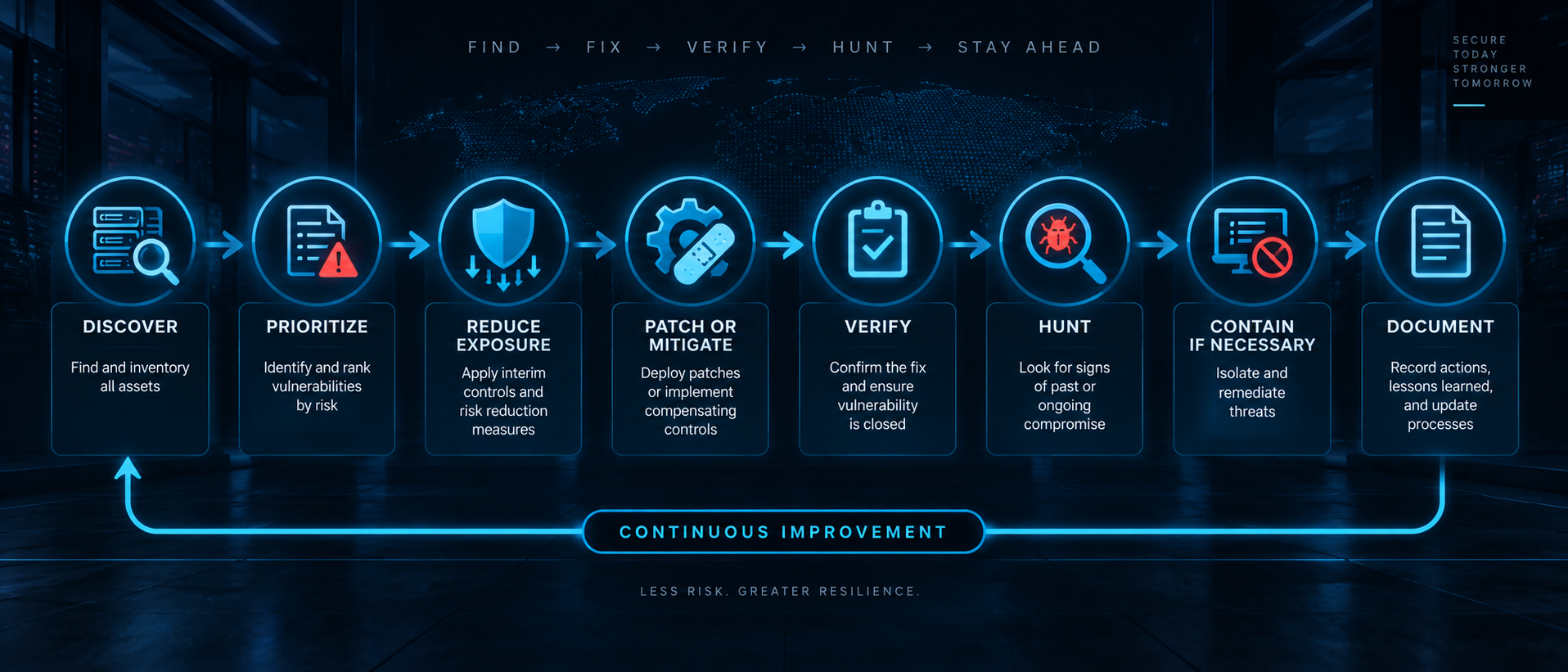
The first step is discovering which systems are affected.
The organization then needs to prioritize those systems based on factors such as severity, exploitability, internet exposure, business importance, and evidence of active exploitation.
The vulnerable condition should be removed or mitigated as quickly as operationally possible.
After remediation, teams should verify that the fix was actually applied.
But for high-risk vulnerabilities, the process should continue.
Security teams should review relevant historical telemetry and determine whether evidence exists that exploitation occurred during the exposure window.
If compromise is identified, incident-response procedures should begin. This may include isolation, credential rotation, forensic investigation, removal of persistence, rebuilding affected systems, and monitoring for attacker re-entry.
Finally, the organization should document what was affected, what actions were taken, and what was discovered.
This creates a much stronger security outcome than simply recording that the patch deployment reached 100%.
How Logstail Can Support This Workflow
Effective vulnerability remediation depends on visibility.
Security teams need to understand what software is deployed, where vulnerabilities exist, which systems require attention, and whether suspicious activity occurred around the affected assets.
This is where Logstail SIEM & SOAR can support the vulnerability-response process.
Rather than treating patching and security monitoring as completely separate activities, organizations can use a centralized security platform to improve visibility across both.
Identify Vulnerable and Outdated Software
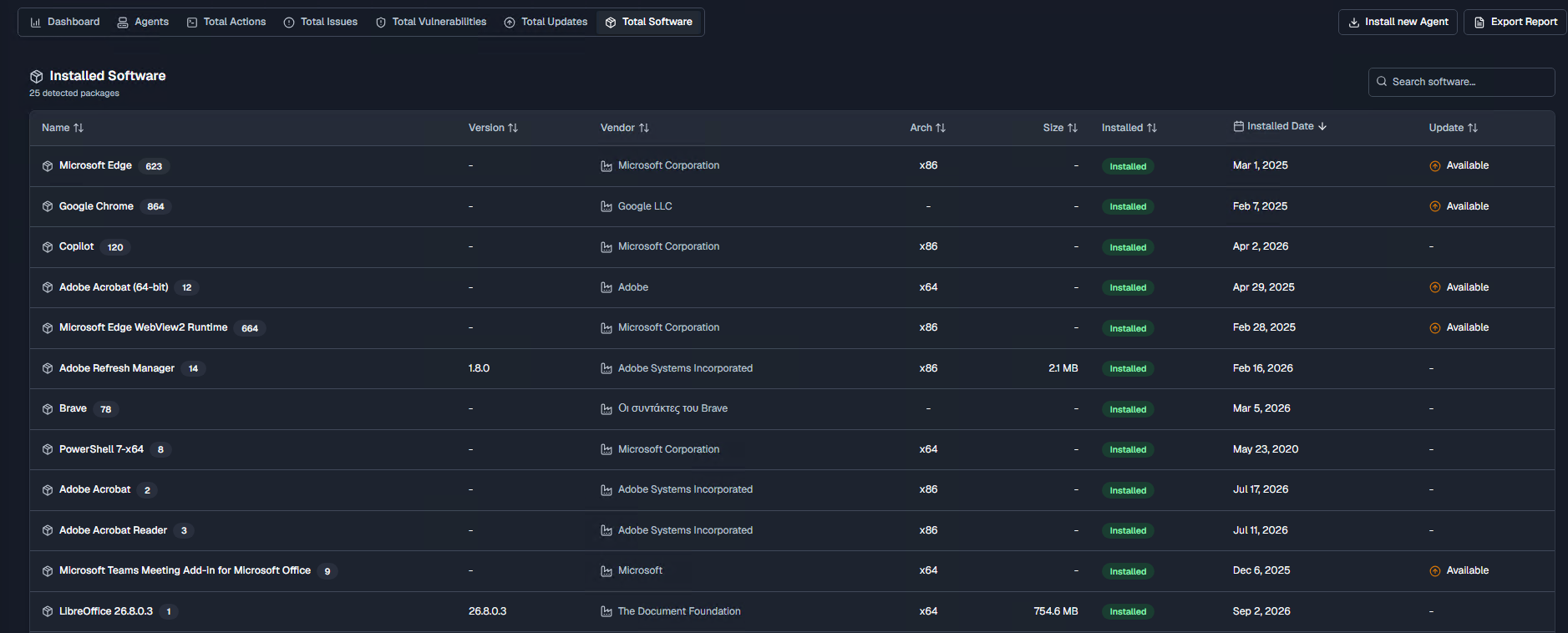
Within the Logstail SIEM & SOAR environment, the Agents module provides visibility into systems connected to the platform.
Security and IT teams can review software and vulnerability information associated with these agents, helping them identify systems running outdated or vulnerable software.
Information such as software versions, architecture, installation information, and available updates can help teams determine which endpoints require remediation.
This matters because vulnerability response begins with knowing where affected software exists.
An organization cannot reliably remediate a vulnerability if it cannot identify all of the systems running the affected software.
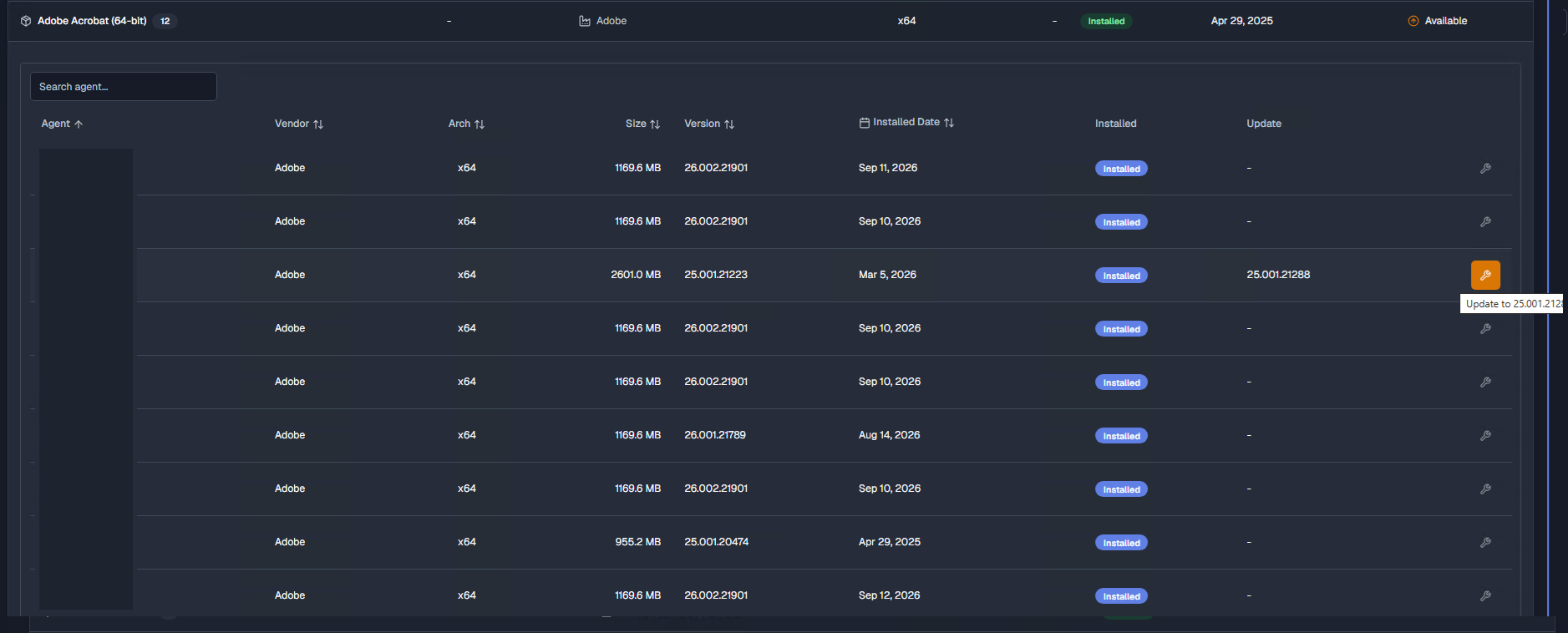
When outdated software is identified, teams can examine where that software is installed and determine which systems require attention.
Supported updates can then be scheduled remotely, helping administrators coordinate remediation across managed systems without relying entirely on manual endpoint-by-endpoint intervention.
The security objective is not simply to increase the number of patches deployed.
It is to reduce the exposure window by identifying affected systems quickly and making remediation easier to coordinate.
Maintain Evidence of the Environment
Documentation is also an important part of vulnerability response.
Security teams should be able to establish which systems were affected, what software versions were installed, what vulnerabilities were identified, and what remediation actions were taken.
Logstail can help teams maintain visibility into agents, software, and vulnerabilities and export information for reporting and review.
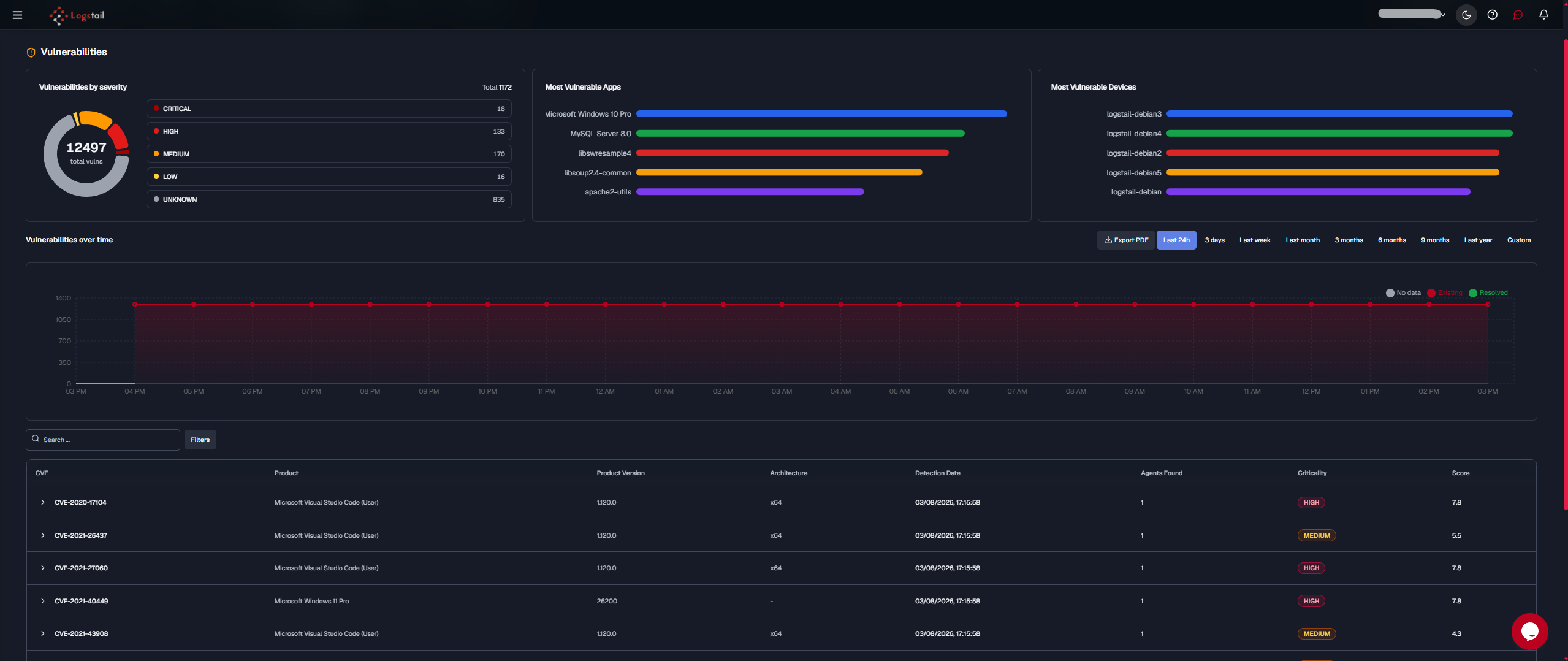
This becomes particularly useful when investigating an incident after remediation.
Instead of relying entirely on memory or manually maintained spreadsheets, teams can retain clearer evidence of the software and vulnerability state observed across managed systems.
Historical context can help answer questions such as:
- Which assets were affected?
- Which versions were installed?
- Which systems required remediation?
- Which assets should receive additional investigation?
Use SIEM Visibility to Investigate the Exposure Window
Patch status alone cannot establish whether exploitation occurred.
Security telemetry is required.
Logstail SIEM & SOAR can help centralize events from across the environment so analysts can investigate suspicious activity associated with affected systems.
Depending on the available integrations and telemetry, analysts may be able to investigate authentication activity, endpoint events, application logs, alerts, administrative actions, network activity, and other indicators associated with the potential compromise.
This allows teams to investigate what happened during the exposure period, rather than simply confirming that the vulnerable software is no longer present.
For example, suppose an internet-facing system remained vulnerable for several days before an update was deployed.
The next step should not necessarily be to close the vulnerability ticket immediately.
The SOC can review relevant telemetry from that period and look for evidence of suspicious access, process execution, credential use, outbound connections, persistence, or lateral movement.
If nothing suspicious is identified, the organization has stronger evidence supporting the remediation decision.
If suspicious behavior is discovered, the vulnerability ticket has effectively become an incident investigation.
Use SOAR to Coordinate Remediation and Response
When investigation identifies suspicious activity, response may require multiple actions across different systems.
CISA’s vulnerability and incident-response guidance describes activities such as limiting access, isolating affected systems, making configuration changes, removing malicious artifacts, resetting compromised credentials, and monitoring for attacker re-entry.
Logstail SOAR can help teams coordinate repeatable response processes through playbooks and supported integrations.
Depending on the environment and available integrations, security teams can build workflows around tasks such as alert enrichment, investigation case creation, notifications, isolation, access restriction, and other approved remediation actions.
This can help reduce repetitive manual work while keeping the response process documented and consistent.
Automation should still be implemented carefully.
The security integrations used by SOAR Playbooks should themselves follow least privilege and receive only the permissions required to perform their approved actions.
A security automation account should not become another overprivileged identity within the organization.
Patching and Threat Hunting Should Work Together
Patch management and threat hunting are often treated as separate security disciplines, but in practice they need to work closely together. The vulnerability management team may know that a server was exposed to a critical vulnerability, while the SOC has the telemetry needed to determine whether suspicious activity occurred during that exposure window. If the situation escalates, the incident-response team may then need to establish whether the compromise remained limited to the original asset or spread further across the environment.
When these teams operate in isolation, important context can easily be lost. A better approach connects vulnerability information with security monitoring and incident response so that each team contributes to the same risk picture. A critical vulnerability affecting an internet-facing system should be more than just another item in a patch queue; it should provide useful context for monitoring and investigation. In the same way, suspicious behavior on a system known to have a critical vulnerability should influence both the urgency and the scope of the response.
Bringing vulnerability management and security operations together helps organizations move beyond simply fixing weaknesses. It allows them to understand whether those weaknesses were actually exploited and whether further investigation or containment is required.
Do Not Stop at “100% Patched”
Reaching 100% patch deployment is a valuable milestone.
But it should not automatically be interpreted as 100% remediation.
A patch tells you something important:
The known vulnerability should no longer be exploitable in the same way on the updated system.
It does not necessarily tell you:
Whether somebody exploited it before the update.
That second question requires visibility, telemetry, investigation, and sometimes a full incident-response process.
Log4Shell demonstrated why organizations need to inventory affected assets, verify remediation, monitor systems, and hunt for compromise.
The SonicWall OVERSTEP investigation demonstrated how credentials stolen during an earlier compromise could allow attackers to return even after systems had been patched.
And broader vulnerability research continues to show that attackers regularly exploit vulnerabilities for which fixes already exist.
The takeaway is not that patching is ineffective.
It is the opposite.
Patch quickly—but do not confuse patching with proof that no compromise occurred.
Strengthen Vulnerability Response With Logstail
Effective vulnerability remediation requires more than identifying CVEs.
Organizations need visibility into affected systems, faster remediation processes, security telemetry, investigation capabilities, automation, and reporting.
Logstail SIEM & SOAR can support this workflow by helping teams identify vulnerable and outdated software across managed agents, coordinate supported software updates, centralize security telemetry, investigate suspicious activity, automate approved response actions, and maintain information that can support reporting and investigation.
This approach supports the broader security practices described in CISA’s vulnerability and incident-response guidance: identify the affected environment, reduce risk, investigate potential compromise, remediate thoroughly, and continue monitoring for malicious activity.
The key principle is simple:
Patch the vulnerability—but investigate the exposure.
Because closing the door matters.
But you still need to know whether someone walked through it before you locked it.
Contact Our Experts or Sign Up for Free